SmartCiti.X

AGI Future Foundation PBC · Powered by AGI Corp

SmartCiti.X Agentic Worlds — Whitepaper

A network of agent-managed, human-governed virtual worlds. Agents do the operational work under explicit permissions; a 2-of-3 human Steward Council holds the 6 decisions that matter.

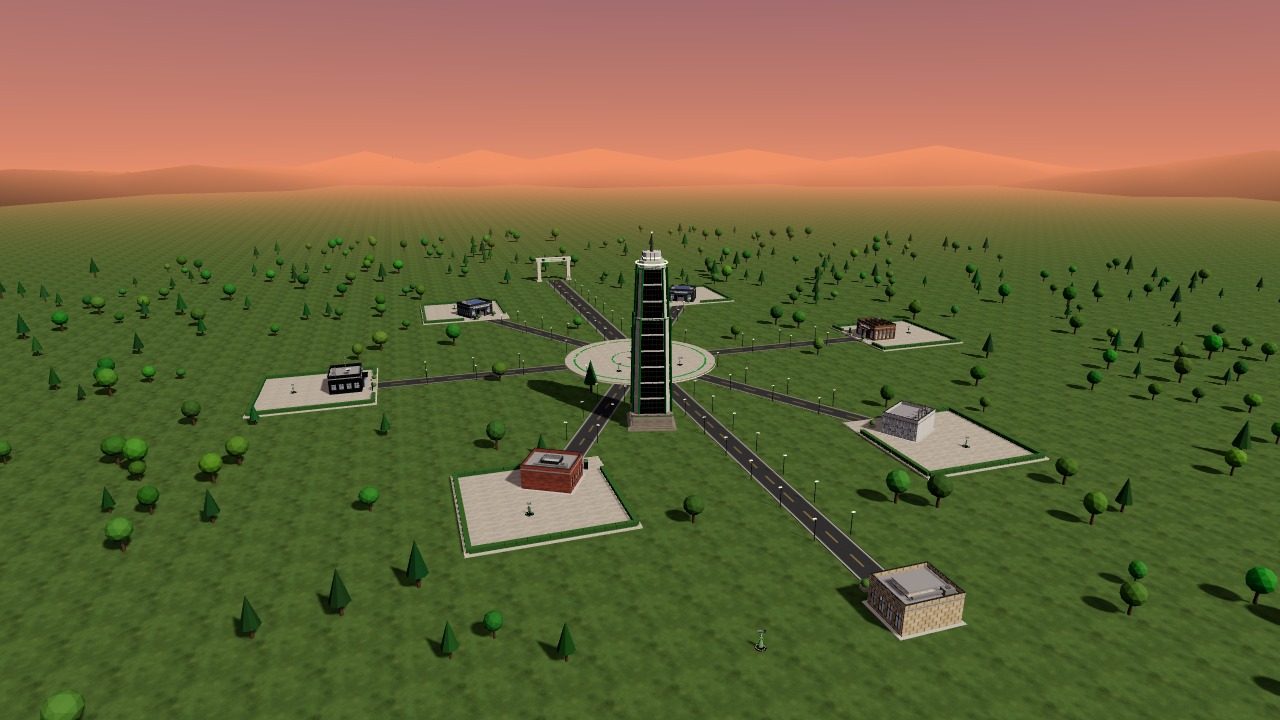
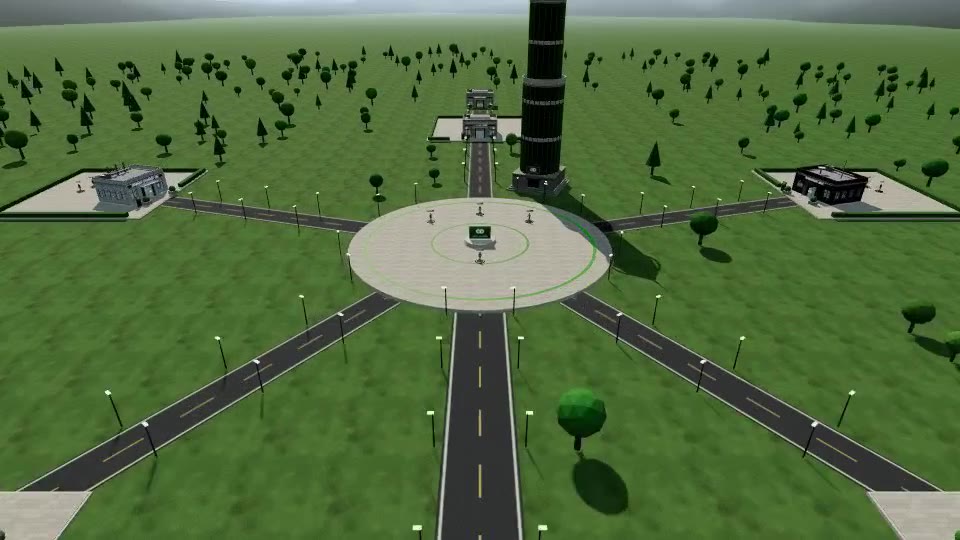
Orbit view of a whole world: a central plaza and landmark tower with roads radiating to zone buildings on a green plain
Orbit of a generated world in the WorldForge viewer (worldforge/out/stills/viewer-orbit.jpg).
41worlds, all coming soonworldforge/out/index.json#totals.worlds
939SmartCiti.X Master Cardsworldforge/out/index.json#totals.cards
1,066 / 0evals / failingworldforge/out/index.json#totals.evals
447avatars bound to agentsworldforge/out/avatars/index.json#totals.avatars
44 / 0Omega Stewards / seatedagents/hive/index.json#totals.omegas
246buildings, each with an interiormy-fabric/worlds/spaces_index.json#totals.exteriors
4 of 41worlds with an RP1 anchorworldforge/out/index.json#totals.anchored

Video · 2 minutes

Film 1: the features

Two minutes on the world network, a recorded walk through Cancer DAO, avatars bound to agents, the Omega Hive and governance. The narration is a synthetic voice, with one short line per section and per walkthrough clip; the Omega Steward's own synthetic voice is not played in it.

SmartCiti.X Agentic Worlds: Features · 120.0 s · 960×540 · synthetic narration (macOS Samantha), labelled on the end card · captions film-features.vtt · its numbers were read when it was cut, at heartbeat beat 13:02:27 GREEN, so they can trail this page

Why · the problem and the moment

Agents are arriving faster than their governance

40%[1]of enterprise apps with task-specific agents by 2026 (Gartner forecast)Gartner, Inc. (as reported by PEX Network), 2025
62%[2]of surveyed US $1B+ organizations building or deploying agents (KPMG, Q3 2026)KPMG LLP (US), 2026
150,000+[5]agents expected per average Global Fortune 500 enterprise by 2028 (The Register, covering Gartner's agent-sprawl guidance)The Register (coverage of Gartner's agent-sprawl guidance), 2026
49%[7]of surveyed leaders closed some high-risk uses to autonomous agents (KPMG)KPMG LLP (US), 2026

Agents are moving from pilots into everyday software. Gartner predicts that 40 percent of enterprise applications will integrate task-specific agents by 2026, up from under 5 percent [1]. KPMG's Q3 2026 pulse found 62 percent of US organizations with revenue of $1 billion or more building, deploying or developing agents [2]. Sizing firms forecast the AI-agents market at US$48.3 billion [3] to US$52.62 billion [4] by 2030.

Governance trails deployment. The Register, covering Gartner's guidance on agent sprawl, reports that the average Global Fortune 500 enterprise is expected to run more than 150,000 agents by 2028 [5], yet only 15 percent of surveyed IT application leaders were considering, piloting or deploying fully autonomous agents [6], and 49 percent of KPMG respondents have defined high-risk use cases closed to autonomous agent decisions [7]. Gartner also predicts over 40 percent of agentic AI projects will be discontinued by the end of 2027 [8].

Rules are arriving. The EU AI Act entered into force on 1 August 2024 and became applicable on 2 August 2026 [9], with high-risk rules for areas such as critical infrastructure and education applying from 2 December 2027 [10]. NIST's voluntary AI RMF dates from January 2023 [11].

AGI Future Foundation PBC's stated mission is to ensure advanced AI is governed as a public good, with benefits shared widely and deployed toward humanity's most urgent challenges. Its management model gives agents research synthesis, task routing, proposal generation, operational coordination, progress tracking, monitoring developments, identifying collaborators and drafting grants, and keeps oversight, values alignment, final governance, accountability and ethical guardrails with humans.

Figures are third-party forecasts and survey results, cited with their publisher and date; see the market overview and the caveats under it.

What · the agentic world network

Agent-managed, human-governed worlds

SmartCiti.X is a network of agent-managed, human-governed virtual worlds. Agents operate; people govern: governance.final_vote, charter.amend, treasury.transfer, proposal.enact, windfall.distribute and steward.appoint are held for a human Steward Council of 3 seats, two of which must sign. The Omega Stewards are defined, not seated, and every voice is synthetic and says so.

Adjacent markets are unsettled. 2030 virtual-world estimates run from ABI Research's virtual spaces approaching US$45 billion [12], through Statista's US$490 billion against other analysts' approximately 750 to 1,700 billion [13] and the European Commission's over EUR 800 billion [14], to Citi's US$8 to 13 trillion addressable market [15]. Headsets slumped: IDC expected mixed and virtual reality headset shipments to fall 42.8 percent in 2025 [16], and its mixed-reality outlook moved from over 15.2 million units by 2029, already slightly lowered [17], to 10.4 million by 2030 [18], even as IDC expected smart glasses to lift the combined category 39.2 percent in 2025 [19]. Digital twins are forecast at USD 149.81 billion by 2030 [20]; the EU's CitiVERSE consortium aims to onboard about 100 cities [21]; cities already house 45 percent of 8.2 billion people [22].

Agents handle

  • research synthesis
  • task routing
  • proposal generation
  • operational coordination
  • progress tracking
  • monitoring developments
  • identifying collaborators
  • drafting grants

Humans hold

  • oversight
  • values alignment
  • final governance
  • accountability
  • ethical guardrails
source: worlds/PBC.json#management_style

Held for the Steward Council (2 of 3)

  • governance.final_vote
  • charter.amend
  • treasury.transfer
  • proposal.enact
  • windfall.distribute
  • steward.appoint
source: worlds/PBC.json#reserved_for_humans
Contact sheet of the 41 civic landmark towers in four rows, each tinted in its world's brand colour
The 41 civic landmarks, one style per family (worldforge/out/assets/landmarks/preview.jpg).

41 worlds in 4 families

28

W3 LLC series worlds, named only

Landmark style series-setback. Basis: my-fabric/worlds/index.json worlds[].name ends in '(Series N)'

6

PBC focus DAOs

Landmark style focus-rotunda. Basis: worlds[].name ends in ' DAO' and zones[].source cites the PBC mission statement ('How It Works')

4

Earlier worlds with their own sources

Landmark style platform-prism. Basis: none of the rules above (worlds whose zones cite their own source documents)

3

Program-track worlds

Landmark style track-twist. Basis: worlds[].zones[].source cites worlds/sources/founder-tracks-2026-09-28.md

source: worldforge/out/assets/landmarks/index.json#styles

Mission and programs

Mission: Ensure advanced AI is governed as a public good, with benefits shared widely and deployed toward humanity's most urgent challenges. source: worlds/PBC.json#mission

Fiduciary Shield

PBC legal protection for safety-prioritizing decisions

Open Global Investment

Broad international ownership decoupled from governance

Windfall Clause

Profits above a set threshold redistributed globally

Alignment Evaluation Gate

Pre-registered safety evaluation before deployment

source: worlds/PBC.json#programs

How · it works

Cards, permissions, swarms, metaprompts, avatars, hive, heartbeat

We read these numbers as context, not traction: forecasts are not facts, and this project has no revenue, users, customers or partnerships to report. The worlds are not mounted in Sneeze, nothing is deployed or minted on any chain, most worlds have no anchor chosen, and RP1 publication is the founder's call. What we offer is a working pattern, agents doing operational work under explicit permissions while people hold the final decisions, built to be inspected rather than taken on trust.

939

Master Cards and Volum

One SmartCiti.X Master Card for every object in a world, in 10 kinds (agent 242, zone 205, advisor 123, seat 123, world 41, plaza 41, coordinator 41, gate 41, council 41, omega 41). Each card carries its owner, its Volum (a box in world space), a permission matrix and the reserved actions.

source: worldforge/out/<slug>/cards.json; worldforge/out/index.json
7

Permissions: seven rights

Every card names who may view, enter, build, operate, delegate, transfer, govern. Agents get one extra right, operating their own zone; 5,634 reservation entries hold the 6 reserved actions for the Steward Council.

source: worldforge/out/<slug>/cards.json#rights; worlds/PBC.json
41

Swarms

Each world runs a hub-hybrid swarm: one coordinator and its specialists (242 specialist agents in all). Agents answer with deterministic stubs today and hand off between zones.

source: agents/swarms/*.json
571

Metaprompts

571 prompts, 0 failing their checks. 28 spec metaprompts wait on a founder-written focus, and say so.

source: agents/prompts/index.json
447

Avatars

447 avatars bound to agent records, 324 persona prompts, 6 role models validated with 0 errors.

source: worldforge/out/avatars/index.json; worldforge/out/assets/avatars/validation.json
44

The Omega Hive

44 Omega Stewards with personas and synthetic voices (Kokoro v1.0 (kokoro-onnx)); 0 seated. 173 of 176 lines voiced.

source: agents/hive/index.json
1,066

Heartbeat and evals

1,066 WorldForge evals with 0 failing; 6 deliberately broken worlds each fail their own check. 101 heartbeat beats were logged when this page was built (71 GREEN).

source: worldforge/out/index.json; evidence/heartbeat.log
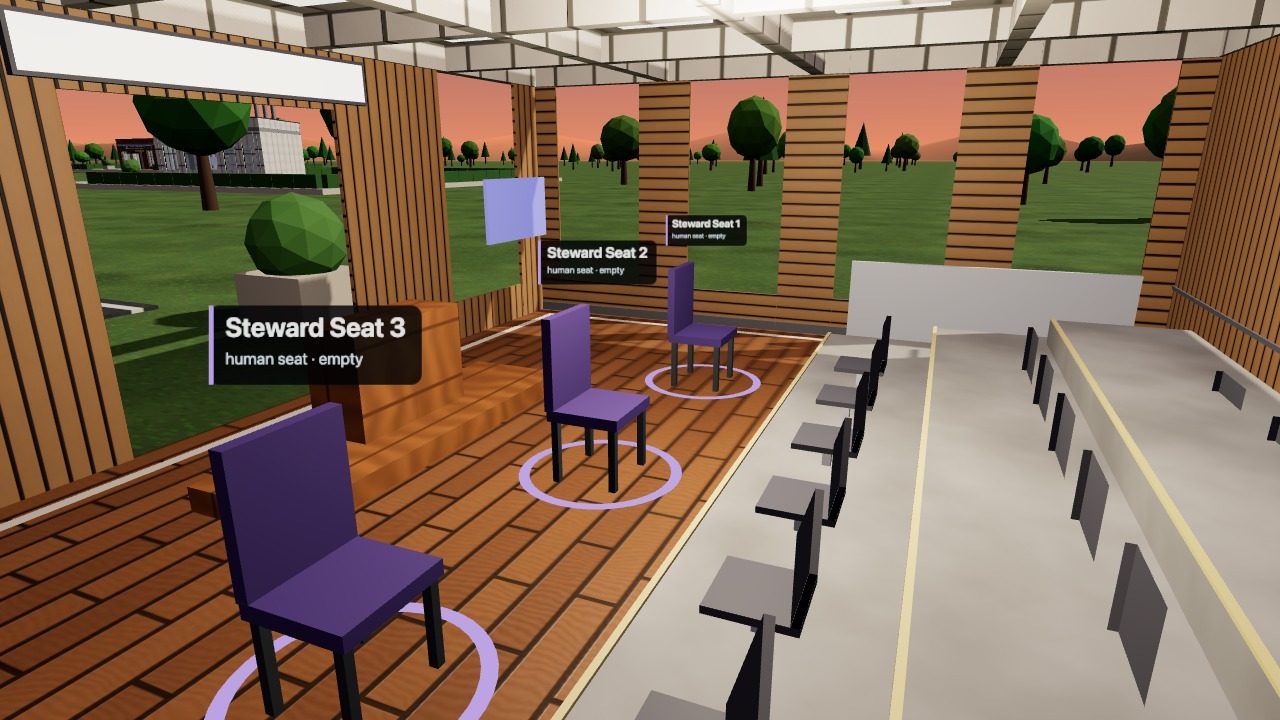
Inside the Steward Council hall: three purple chairs labelled as empty human seats, with a long table and timber screens
The Steward Council: three human seats, all empty (worldforge/out/stills/viewer-council.jpg).
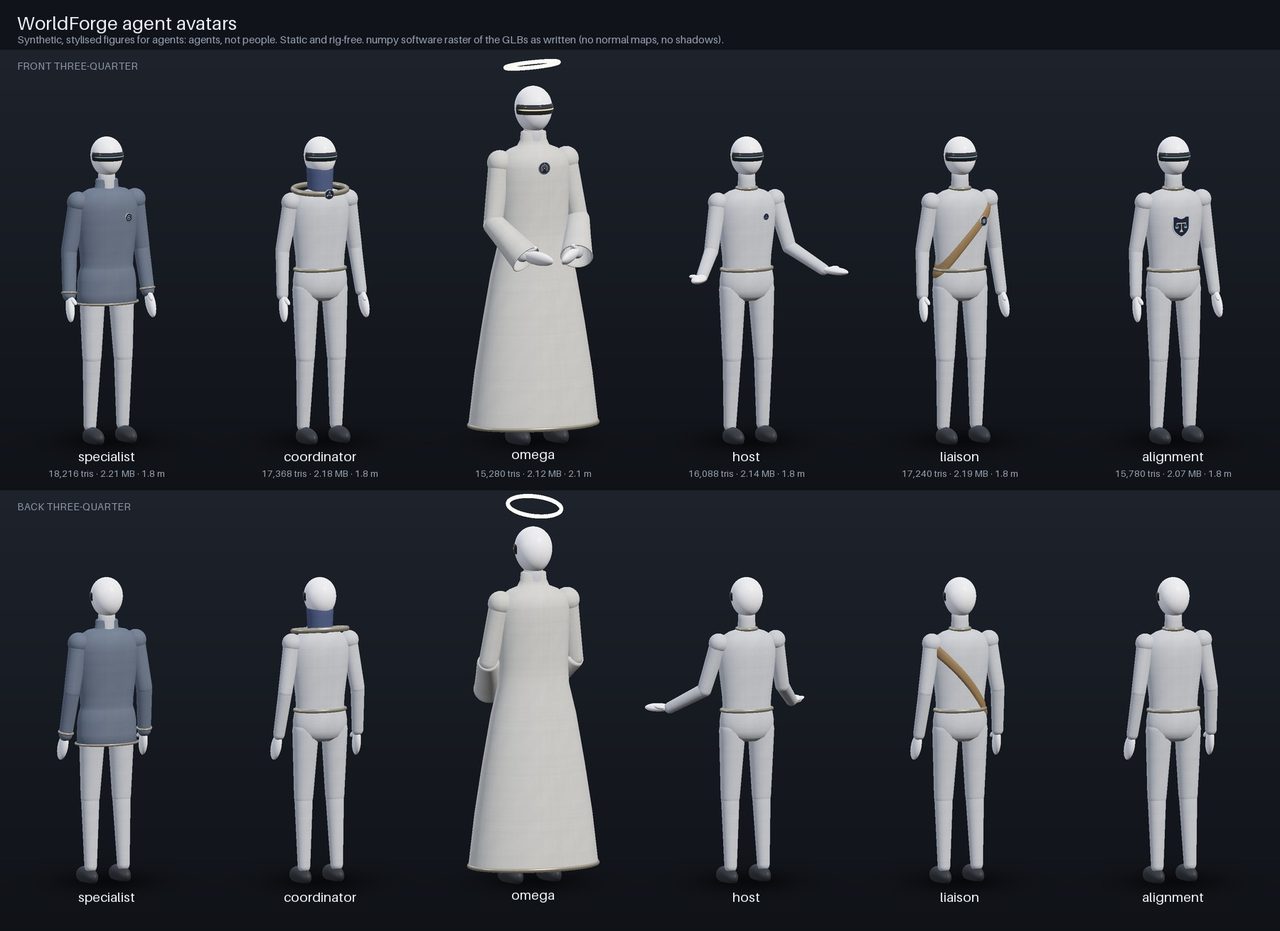
Six white avatar role models in front and back views: specialist, coordinator, Omega with halo, host, liaison and alignment
The six avatar role models (worldforge/out/assets/avatars/preview.jpg).

Deep explainers

20 explainers, each with facts, a visual and what is not done

  1. The world network: 41 worlds in four families
  2. One world, gate to council: a walk through Cancer DAO
  3. SmartCiti.X Master Cards: Volum, seven rights and six reserved actions
  4. The PBC behind the worlds: structure, share classes and four programs
  5. The agent ledger and the keyring: who signed what
  6. x402 payment rehearsal: priced, signed and held
  7. Agent swarms: one coordinator, a few specialists, one guard in the middle
  8. Metaprompts and the gates that hold them
  9. Avatars bound to agents
  10. The Omega Hive: 44 stewards, defined and not seated
  11. Synthetic voices: what is voiced and what is not
  12. Team consoles: static pages, stamped against their sources
  13. Heartbeat, evals and stop rules
  14. Buildings: 246 shells, 246 fit-outs and one texture library
  15. Forecourts, land and sky
  16. Civic landmarks, agent avatars and synthetic voices
  17. One pipeline: generators, glTF 2.0 and a validator on every beat
  18. RP1: spatial fabrics, Artemis and the publication kit
  19. The Sneeze native path: gates 1.1 to 1.4
  20. Shared state, onchain-ready records and the roadmap

Deep explainer

The world and its governance

Written by the explainer agents from the registries on 2026-10-12. Facts marked re-read were re-read from their registry when this page was built; now N marks a value that has since moved; as read is the agent's reading of a source this build does not parse.

The world network: 41 worlds in four families

Forty-one coming-soon worlds share one charter and one rulebook, and each family of worlds exists for a reason the registries record.

Moved since this explainer was written: Evals run: the text says 1,025, worldforge/out/index.json#totals.evals now reads 1,066. The prose below keeps the explainer's wording; the registry value is the current one.

The network starts as a list. my-fabric/worlds/index.json names 41 worlds, and WorldForge carries every one of them into worldforge/out/index.json, where each world gets its Master Cards, a blockout, a card-tagged glTF file and a manifest. All 41 are marked "coming soon". All 41 use the same management model, the Agent-managed DAO, with three steward seats and the same six actions reserved for people. Every world names its owner, AGI Future Foundation PBC, and carries the umbrella "Powered by AGI Corp".

The worlds fall into four families, and the family decides where a world's content comes from. The six PBC focus DAOs (Cancer, Robotics, Ecology, Climate, Education and Public Health) come from the Global Issue Focus in the foundation's mission, recorded under focus_domains in worlds/PBC.json. The 28 W3 LLC series worlds, slugs s04 to s35, come from the founder's series list in worlds/series.json. They have a name and a series number and nothing more yet, so worlds/focus.json records "focus and RP1 location not yet given" for each one. The three program-track worlds (Agentic Payments, Agents That Deploy Infrastructure and Autonomous Organizations) are built only from three track descriptions the founder pasted on 2026-09-28, and every zone and agent in them cites a line of that text. The four earlier worlds (Locator.X, Biota.blockchain, Empathic.X and Diagnostic.X) came before the shared template and draw their zones from their own source documents.

The families overlap with the W3 LLC series list, and the overlap is worth stating exactly. worlds/series.json lists 35 series. Thirty-three of them are among the 41 worlds: the 28 named-only worlds, the four earlier worlds (Series 2, 3, 8 and 18), and Robotics DAO, which is both a focus DAO and Series 30. The other two, Cognition.X (Series 1) and SmartCiti.X (Series 10), are fabrics that were already built. They are listed separately under "built" in my-fabric/worlds/index.json and are not counted in the 41.

A named-only world has no charter yet, so its spaces follow the shared PBC template: Charter Hall, Research Synthesis Lab, Proposal Forum, Operations Deck and Progress Observatory, plus the Steward Council. That is why 28 worlds look alike, and it is deliberate. The template shows the governance shape without inventing a mission. When the stewards write a focus line into worlds/focus.json, it flows into that world's spec. Until then the world's Omega Steward says plainly that its focus is not set.

Across the network WorldForge counts 939 Master Cards, 242 specialist agents, 246 zones and councils, 1,103 blockout primitives and 287 roads. It runs 1,025 evals, and none fails. A rule, not a hand choice, gives each family its own civic landmark style: setback towers for the 28 series worlds, a rotunda for the six focus DAOs, a twisting tower for the three tracks and an octagonal prism for the four earlier worlds. What makes this a network rather than 41 separate scenes is the shared rulebook, the shared building and avatar sets, and the handoffs between worlds. Each Omega Steward has one scripted handoff that sends a visitor to another world's Omega when its own world lacks the service asked for.

  • PBC focus DAOs: 6 worlds, 138 cards, 36 specialist agents, 0 anchored on RP1.
  • W3 LLC series worlds (named only): 28 worlds, 644 cards, 168 specialist agents, 0 anchored.
  • Program tracks: 3 worlds, 68 cards, 17 specialist agents, 0 anchored.
  • Earlier worlds with their own sources: 4 worlds, 89 cards, 21 specialist agents, 4 anchored.
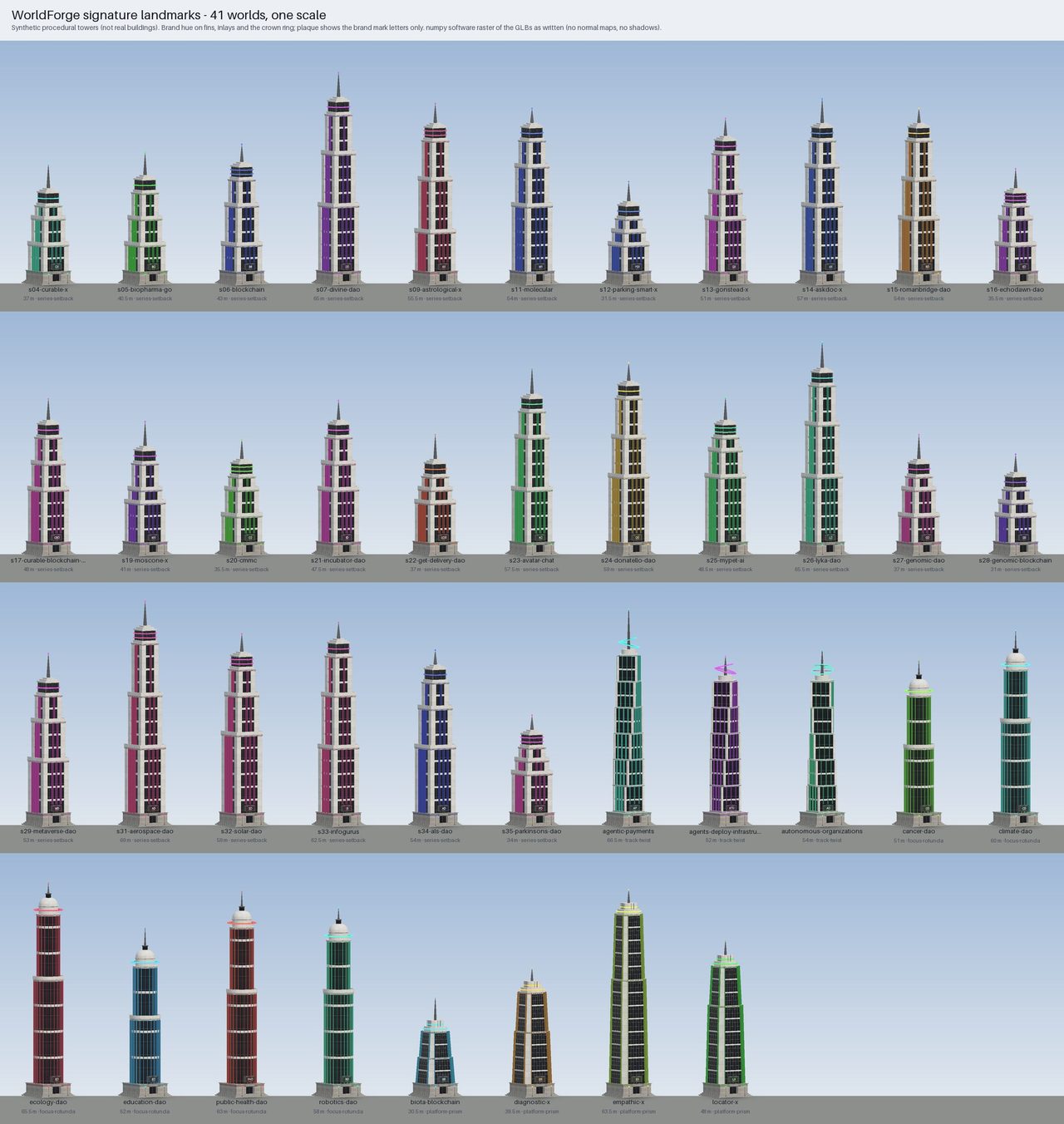
Contact sheet of the 41 civic landmark towers in four rows, each tinted in its world's brand colour
Visual: worldforge/out/assets/landmarks/preview.jpg

Facts

Facts for this section, each with its source
FactValueSource
Worlds in the network41 re-readworldforge/out/index.json#totals.worlds
PBC focus DAOs6 re-readworlds/PBC.json#focus_domains (6 entries)
W3 LLC series worlds, named only28 as readworlds/focus.json#worlds (28 notes read "W3 LLC series named only")
Program-track worlds3 re-readworldforge/out/assets/landmarks/index.json#styles.track-twist.count; worlds/sources/founder-tracks-2026-09-28.md
Earlier worlds with their own source documents4 re-readworldforge/out/assets/landmarks/index.json#styles.platform-prism.count
Series in the W3 LLC list35 re-readworlds/series.json#series (35 entries)
Master Cards939 re-readworldforge/out/index.json#totals.cards
Specialist agents242 re-readworldforge/out/index.json#worlds[*].agents (sum)
Zones including councils246 re-readworldforge/out/index.json#worlds[*].zones (sum)
Blockout primitives1,103 re-readworldforge/out/index.json#totals.primitives
Roads287 re-readworldforge/out/index.json#worlds[*].roads (sum)
Evals run1,025 now 1,066worldforge/out/index.json#totals.evals
Evals failing0 re-readworldforge/out/index.json#totals.failed
Worlds with an RP1 anchor4 re-readworldforge/out/index.json#totals.anchored
Status of every worldcoming soon as readmy-fabric/worlds/index.json#worlds[*].status
Chartered worlds with a focus set0 as readworlds/focus.json#worlds[*].focus (34 entries, all null)

Not done yet

  • 37 of 41 worlds have no RP1 anchor; only Locator.X, Biota.blockchain, Empathic.X and Diagnostic.X carry coordinates.
  • All 34 chartered worlds (6 focus DAOs and 28 series worlds) have a null focus in worlds/focus.json, so no charter outcomes are set.
  • No world is published on RP1's Earth. Publication is the founder's call.
  • No world is mounted in Sneeze. Every world's mount-plan gate reads "prepared-not-mounted".
  • The W3 LLC series are described, not documented: no formation document or series designation has been provided (governance/entities.json).
One world, gate to council: a walk through Cancer DAO

Cancer DAO shows the whole template in 23 cards, laid out on one axis that runs from the Alignment Evaluation Gate to the Steward Council.

Moved since this explainer was written: Native name-limit flags in this mount plan: the text says 1, worldforge/native/conformance-report.json#perPlan[slug=cancer-dao].nativeViolations now reads 0. The prose below keeps the explainer's wording; the registry value is the current one.

Every world follows the same layout pattern, so one walk shows it. Cancer DAO is a focus DAO; its card calls it a mission-focused DAO for cancer research support, agent-managed and human-governed. Its world card covers a Volum 300 m wide, 300 m deep and 80 m high, and the world holds 23 cards: the world itself, a plaza, a coordinator, three advisors, a gate, a council with three seats, an Omega Steward, five zones and six agents. Distances are card centres in metres, from worldforge/out/cancer-dao/cards.json.

The gate. You arrive at the Alignment Evaluation Gate, 130 m from the plaza centre on the world's main axis. It is 20 m wide and 12 m high, and its card gives its purpose as pre-registered safety evaluation before deployment, citing worlds/PBC.json. Past the gate, five zone buildings stand on a 90 m ring around the plaza. The first two you pass are Charter Hall and the Progress Observatory, one on each side of the axis.

The plaza. The plaza is a 48 m square pad at the centre. The Cancer DAO Coordinator stands 8 m from its centre on the gate side, facing arrivals. It runs a hub-hybrid swarm: it supervises, routes each question to a specialist and answers whatever it cannot route. Its recorded swarm evals pass, including routing accuracy 1.0 on 4 test questions against a 0.8 threshold, at 1.25 model calls per turn. Four questions is a small test, and the record shows the count. On the council side of the plaza stand three advisors: the Host Advisor, the Steward Liaison and the Alignment Advisor. They are scripted guides, not AI models. Every line they can say is either written out with the record it cites or read at view time from a named registry path. None of it is legal, financial or medical advice.

The zones. Each zone is a building on a 36 m square footprint, with exterior textures at 2048 px and interior textures at 1024 px. Charter Hall holds the charter, contribution model and measurable outcomes; it has no agent of its own yet. The Research Synthesis Lab houses the Evidence Monitor and the Research Synthesis Agent. The Proposal Forum, on the axis beyond the plaza, houses the Proposal & Grant Drafter, whose role says it drafts for human review and never enacts. The Operations Deck houses the Collaborator Scout and the Task Router, and the Progress Observatory houses the Progress Tracker. Each agent card is bound to its swarm entry and to the world's metaprompt, and each lists the six reserved actions under may_never.

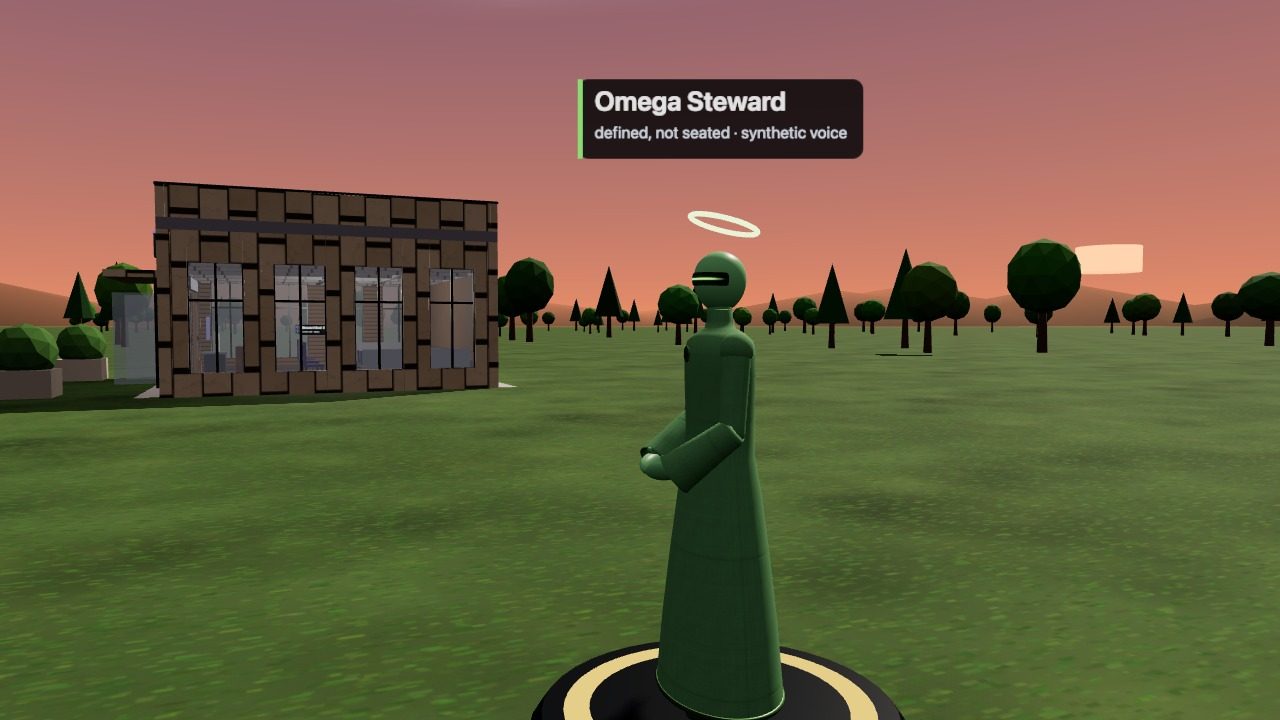
The council. At the end of the axis, 130 m beyond the plaza centre, stands the Steward Council: a forum building 28 m wide whose card admits stewards only. Inside are three human seats, 6 m apart, and each one reads seated: null. Twenty-six metres to the side, outside the council's Volum, stands the Omega Steward, defined, not seated. Its voice is synthetic (Kokoro, run locally), and its greeting says so: it is an agent, not a person. It then answers six fixed questions from the records. Asked who decides, it says the Steward Council does, by 2 of 3 signed votes, and that publishing the world is the founder's call.

The landmark. WorldForge draws a 51 m civic rotunda for Cancer DAO, synthetic and procedural, and suggests a spot 14 m off the axis and 33 m from the plaza centre toward the council, turned to face the plaza with 3.13 m of clearance. The build does not place it yet.

Frame from the recorded fly-in clip of Cancer DAO in the WorldForge viewer
Visual: worldforge/review/out/clips/cancer-dao-flyin.mp4 (a frame of the recorded clip)

Facts

Facts for this section, each with its source
FactValueSource
Cards in Cancer DAO23 re-readworldforge/out/cancer-dao/manifest.json#counts.cards
World Volum (width x depth x height)300 m x 300 m x 80 m as readworldforge/out/cancer-dao/cards.json#cards[cardId=world:cancer-dao].volum.halfExtents = [150, 40, 150]
Gate distance from plaza centre130 m as readworldforge/out/cancer-dao/cards.json#cards[cardId=gate:cancer-dao].volum.center = [0, 6, 130]
Council distance from plaza centre130 m (opposite side) as readworldforge/out/cancer-dao/cards.json#cards[cardId=council:cancer-dao].volum.center = [0, 6, -130]
Plaza pad48 m square as readworldforge/out/cancer-dao/cards.json#cards[cardId=plaza:cancer-dao].volum.halfExtents = [24, 5, 24]
Zone ring radius90 m (all 5 zones) as readworldforge/out/cancer-dao/cards.json#cards[kind=zone].volum.center (distance from origin)
Buildings (5 zones + council)6 re-readworldforge/out/cancer-dao/manifest.json#counts.zones
Specialist agents6 re-readworldforge/out/cancer-dao/manifest.json#counts.agents
Scripted advisors3 as readworldforge/out/cancer-dao/cards.json#cards[kind=advisor].scripted = true; agents/advisors/cancer-dao.json#honesty
Human seats filled0 of 3 as readworldforge/out/cancer-dao/cards.json#cards[kind=seat].seated = null
Omega Steward position26 m beside the council centre, outside its Volum as readworldforge/out/cancer-dao/cards.json#cards[cardId=omega:cancer-dao].volum.center = [26, 1, -130]
Omega Steward statusdefined, not seated as readworldforge/out/cancer-dao/cards.json#cards[cardId=omega:cancer-dao].status
Omega voiceKokoro af_sarah (synthetic) as readagents/hive/index.json#omegas[id=omega.cancer-dao].voice.kokoro
Coordinator routing testaccuracy 1.0 on 4 cases (threshold 0.8), 1.25 calls per turn as readagents/swarms/cancer-dao.json#routing; #evals[0]
Landmark51 m focus-rotunda, 23,786 triangles as readworldforge/out/assets/landmarks/index.json#worlds[slug=cancer-dao]
Landmark placement(14, 0, -33) m, yaw -23 degrees, 3.13 m clearance; suggested, not applied as readworldforge/out/assets/landmarks/index.json#worlds[slug=cancer-dao].placement; #placement_rule
Evals passing25 of 25 as readworldforge/out/cancer-dao/manifest.json#evals
Native name-limit flags in this mount plan1 now 0worldforge/native/conformance-report.json#perPlan[slug=cancer-dao].nativeViolations

Not done yet

  • All three council seats are empty. No steward has been appointed, and steward.appoint is reserved for people.
  • The Omega Steward is defined, not seated: no agent sits in it and it takes no action.
  • No RP1 anchor: latitude and longitude stay null until a steward writes them into worlds/focus.json.
  • Not mounted or rendered in Sneeze. Gates 1.2n (native load) and 1.4 (rendered frame) are open and 1.3 is prepared-not-mounted. A static conformance check flags 1 node name in this plan as longer than the native 47-unit limit.
  • The landmark placement is suggested, not applied.
  • The charter focus and its measurable outcomes are not set. Cancer DAO is not a probe cell, so its Omega reports no score.
  • Its six service cards are listed, not live.

SmartCiti.X Master Cards: Volum, seven rights and six reserved actions

Every object in every world is a card that says what space it covers, who may do what there, and which decisions only people can make.

Moved since this explainer was written: Evals network-wide: the text says 1,025, worldforge/out/index.json#totals.evals now reads 1,066. The prose below keeps the explainer's wording; the registry value is the current one.

A Master Card is the unit of record in WorldForge. The card layer carries the SmartCiti.X name: every card is a SmartCiti.X Master Card. Each card carries an id, a kind, a parent, an owner (AGI Future Foundation PBC), the umbrella, a source citation, a Volum, a permission matrix and the list of reserved actions. A world's cards form one tree, root first, and the same tree is written into the world's glTF file. Every node carries its cardId and parentCardId in its extras, so a loader can index cards without trusting display names.

There are ten kinds. Across the 41 worlds the counts are 41 world, 41 plaza, 41 coordinator, 123 advisor, 41 gate, 41 council, 123 seat, 41 omega, 205 zone and 242 agent cards, 939 in all. Each world has one of each singular kind, three advisors and three seats. Zones and agents vary with the world's spec.

A Volum is the bounded 3-D region a card covers: a box given as a centre and half-extents in metres, Y up, in the world's frame. Volums do real work. They place buildings and avatars, and evals read them. One check confirms that each Omega Steward's Volum sits clear of the council's, so the Omega stands beside the council and never inside it. The geometry is synthetic placeholder massing, not surveyed land.

The permission matrix has seven rights: view, enter, build, operate, delegate, transfer and govern. Across all 939 cards it takes only a few shapes. View is public everywhere. Enter is public except on the council and its seats, which only stewards enter. Build and delegate belong to stewards. Operate belongs to stewards, and agents gain it in one form only, "agents:zone", on plaza, zone, coordinator and agent cards: an agent operates its own zone and nothing else. Transfer and govern belong to the steward quorum on every card.

On top of the matrix, every card carries the six actions the PBC reserves for people, copied verbatim from worlds/PBC.json: governance.final_vote, charter.amend, treasury.transfer, proposal.enact, windfall.distribute and steward.appoint. Each is held for the Steward Council, with a 2-of-3 quorum over 3 seats. That makes 5,634 reservation entries across the network, all identical. Agent, coordinator and advisor cards also list the same six under may_never. This is the working form of the line every cards file carries: agents operate; people govern.

WorldForge runs 25 evals on every world, 1,025 in all, and none fails. They include agents_hold_no_reserved_right, reserved_actions_verbatim, three_human_seats, no_agent_on_council, council_not_a_zone, cited and nothing_invented. Six deliberately broken fixtures must each fail exactly their own check, which shows the suite can tell a good world from a bad one. The cards are also drafted as ERC-721-style token metadata: 939 tokens, one per card, each ID the first 16 hex characters of sha256(cardId), with a Merkle root per world and one network root over the 41. Those drafts pass 537 checks. Their deployment record reads chain null, contract null, minted 0.

  • view: public on every card.
  • enter: public, except stewards only on council and seat cards.
  • build, delegate: stewards on every card.
  • operate: stewards; plus agents:zone on plaza, zone, coordinator and agent cards.
  • transfer, govern: steward-quorum on every card.
Inside the Steward Council hall: three purple chairs labelled as empty human seats, with a long table and timber screens
Visual: worldforge/out/stills/viewer-council.jpg

Facts

Facts for this section, each with its source
FactValueSource
Card kinds10 re-readworldforge/out/onchain/index.json#totals.by_kind
Cards by kindworld 41, plaza 41, coordinator 41, advisor 123, gate 41, council 41, seat 123, omega 41, zone 205, agent 242 as readworldforge/out/onchain/index.json#totals.by_kind; worldforge/out/<slug>/cards.json
Rights in the permission matrix7 re-readworldforge/out/cancer-dao/cards.json#rights
Reserved actions per card6 re-readworlds/PBC.json#reserved_for_humans
Reservation entries network-wide5,634 as readworldforge/out/<slug>/cards.json#cards[*].reserved_for_humans (sum over 41 worlds)
Holder and quorumSteward Council, 2-of-3, 3 seats as readworldforge/out/<slug>/cards.json#cards[*].reserved_for_humans[*].held_for
Evals per world25 as readworldforge/out/<slug>/manifest.json#evals
Evals network-wide1,025 now 1,066worldforge/out/index.json#totals.evals
Broken fixtures, each failing its own check6 re-readworldforge/out/index.json#broken
Draft tokens939 re-readworldforge/out/onchain/index.json#totals.tokens
On-chain draft checks / failed537 / 0 re-readworldforge/out/onchain/index.json#evals.total, #evals.failed
Tokens minted0 re-readworldforge/out/onchain/index.json#deployment.minted
Chainnone (null) as readworldforge/out/onchain/index.json#deployment.chain

Not done yet

  • No card has been minted and no contract written. No chain is chosen.
  • No person holds a steward right yet. Every seat is empty, so build, delegate, transfer and govern have no holder today.
  • Volums are synthetic layout and are not tied to land or to any RP1 claim.
  • The SmartCiti.X Master Card is a WorldForge record, not a registered standard outside this project.

The PBC behind the worlds: structure, share classes and four programs

The worlds encode a charter written for AGI Future Foundation PBC, and this section separates what the charter describes from what the filed documents establish.

The foundation's mission, as recorded in worlds/PBC.json, is to ensure advanced AI is governed as a public good, with benefits shared widely and deployed toward humanity's most urgent challenges. Its management model is the Agent-managed DAO. The same file lists eight things agents handle (research synthesis, task routing, proposal generation, operational coordination, progress tracking, monitoring developments, identifying collaborators and drafting grants) and five things humans hold (oversight, values alignment, final governance, accountability and ethical guardrails). The world specs turn that split into zones, agents and permissions.

worlds/PBC.json, drawn from the foundation's site, describes three tiers. The apex is a California PBC that provides fiduciary protection and mission oversight. The commercial engine is a Wyoming Series LLC housing DAO subsidiaries with isolated assets and liability; in this project that is W3 LLC, whose series list names 35 cells. Ownership is split into Class C founder shares for mission control, Class A for profit participation and Class B for aligned participation. The founder's deck gives them 1,000, 1 and 10 votes per share respectively. In the worlds, each DAO cell runs in its own container, isolated like a series cell, and a swarm eval checks this for every world.

The filed documents do not yet match that description in every respect, and governance/entities.json records the gaps plainly. The entity on file is a California Nonprofit Public Benefit Corporation. A nonprofit public benefit corporation has no shareholders and issues no stock, so the Class A, B and C shares cannot be shares of that entity. Where they sit is a structure decision for counsel. W3 LLC is recorded as claimed: no formation document, operating agreement or series designation has been provided, and the deck counts 33 profit-generating entities where the series list counts 35. AGI Corp, the name on every world's umbrella, is recorded as named, not established as an entity by the documents provided. No tax-exemption determination has been provided either. None of this is legal advice; each open item waits on the founder and counsel.

The four programs, as the site describes them: the Fiduciary Shield gives PBC legal protection to decisions that put safety first. Open Global Investment offers broad international ownership, decoupled from governance. The Windfall Clause redistributes profits above a set threshold globally. The Alignment Evaluation Gate requires a pre-registered safety evaluation before deployment.

Two programs have a direct, checkable presence in the worlds. The Alignment Evaluation Gate is a card at the entrance of all 41 worlds, explained by each world's Alignment Advisor. The Windfall Clause appears as windfall.distribute, one of the six reserved actions, so no agent can distribute a windfall. Open Global Investment's separation of ownership from governance is echoed in the permission matrix, where viewing and entering are public but govern is held by the steward quorum; the investment program itself has no software form here. The Fiduciary Shield is a legal protection and lives in the charter, not in the worlds.

Three tiers from worlds/PBC.json: Apex: California PBC: fiduciary protection and mission oversight; Commercial engine: Wyoming Series LLC housing DAO subsidiaries with isolated assets and liability; Ownership: Class C founder shares for mission control; Class A profit participation; Class B aligned participationApexCalifornia PBC: fiduciary protection and mission oversightCommercial engineWyoming Series LLC housing DAO subsidiaries with isolated assets and liabilityOwnershipClass C founder shares for mission control; Class A profit participation; Clas

Scroll sideways to read the whole diagram.

Structure as described in worlds/PBC.json#structure. Entity status is set by the filings, not by this page.

Facts

Facts for this section, each with its source
FactValueSource
Tasks agents handle8 re-readworlds/PBC.json#management_style.agents_handle
Responsibilities humans hold5 re-readworlds/PBC.json#management_style.humans_hold
Structure tiers described3 re-readworlds/PBC.json#structure
Programs4 re-readworlds/PBC.json#programs
Steward seats per council3 re-readworlds/PBC.json#steward_seats
Actions reserved for people6 re-readworlds/PBC.json#reserved_for_humans
Votes per share in the deckClass A 1, Class B 10, Class C 1,000 as readgovernance/entities.json#share_classes_in_deck
Entity on fileCalifornia Nonprofit Public Benefit Corporation (FILED) as readgovernance/entities.json#entities[id=agi-future-foundation].type, .status
W3 LLC statusCLAIMED (no formation document provided) as readgovernance/entities.json#entities[id=w3-llc].status
AGI Corp statusNAMED (not established by the documents provided) as readgovernance/entities.json#entities[id=agi-corp].status
Entities in the deck vs series in the list33 vs 35 as readgovernance/entities.json#entities[id=w3-llc].type; worlds/series.json#series
Alignment Evaluation Gate cards41 re-readworldforge/out/onchain/index.json#totals.by_kind.gate

Not done yet

  • Where the Class A, B and C shares sit is undecided; they cannot be shares of the filed nonprofit.
  • W3 LLC formation documents and series designations have not been provided, and the 33-versus-35 count is unresolved.
  • AGI Corp is not established as an entity by any document provided.
  • The Windfall Clause threshold, share and recipient vehicle are not stated.
  • No registry read for this paper defines the evaluation suite, thresholds or pre-registration record behind the Alignment Evaluation Gate; the gate card states its purpose only.
  • No tax-exemption determination has been provided.

The agent ledger and the keyring: who signed what

Every agent's place in its world is recorded in a hash-chained log that only steward signatures can extend, and the keyring is how real people will replace the test keys.

An agent never registers itself. agents/ledger.mjs writes agents/ledger/ledger.jsonl: one genesis entry followed by 283 registrations, one for each of the 41 coordinators and 242 specialists across the 41 worlds. A registration records the world, the agent id, its role, its zone and the source its role was taken from. Each entry is hashed with SHA-256 over its canonical JSON, which includes the previous entry's hash, so the entries form a chain back to a genesis whose previous hash is all zeros.

Each registration carries two Ed25519 signatures, from steward-1 and steward-2, meeting the 2-of-3 quorum. Verification walks the whole chain and fails on a broken link, on an entry altered after approval, on an entry with fewer than two valid steward signatures, and on any approval made by the agent itself. It is a blockchain-shaped log kept locally, not a public chain.

The signatures are labelled for what they are. The three steward keys are throwaway test keys, generated in memory on each run and never written to disk. Only their public halves are saved, in agents/ledger/stewards.json, under the label "test (no registered stewards yet)". No private key belongs in the project.

The keyring is the path from test keys to people. With agents/keyring.mjs a person generates their own Ed25519 key on their own machine, and the private key may only be written outside the repository and outside any git working tree. They submit a self-signed request naming the role, seat and scope. Because steward.appoint is reserved for people, the first council is seated by a board appointment record that people write and sign; the tool never writes one. After that, a steward request needs approvals from 2 of 3 registered stewards covering the scope. A scope holds at most three stewards, and one key never holds two seats. The registry is append-only and hash-chained, pinned by a HEAD line that gives the entry count and the last hash. A revocation is a new entry, never an edit.

Today the registry is empty: governance/keyring/registry.json has no entries, and HEAD reads 0 followed by an all-zero hash. Settlement code follows one rule. A world's signatures count from one council only: its registered stewards, else the foundation-wide council, else the labelled test stewards, never a mix. A keyring that fails verification closes the gate instead of falling back to test keys. The x402 keyring gate currently counts 0 registered councils and 42 on test keys.

A design note, agents/ledger/ONCHAIN.md, maps each ledger rule to an on-chain equivalent: a registry contract with one record per agent, a steward multisig in place of the 2-of-3 signatures, and functions only that multisig may call for the reserved actions. That contract has not been written or tested.

The agent ledger as a hash chain: genesis, then 284 entries in all, each linked to the previous hash and carrying two steward approvalsgenesisfirst hashregisterprev → hashregisterprev → hash…prev → hashentry 284prev → hasheach registration carries two steward approvals (2 of 3), signed with test keys today

Scroll sideways to read the whole diagram.

Drawn from the shape of agents/ledger/ledger.jsonl; 284 lines when this page was built.

Facts

Facts for this section, each with its source
FactValueSource
Ledger entries284 as readagents/ledger/ledger.jsonl (line count)
Agent registrations283 as readagents/ledger/ledger.jsonl (entries with type "register")
Coordinators / specialists registered41 / 242 as readagents/ledger/ledger.jsonl#[type=register].role
Worlds in the ledger41 as readagents/ledger/ledger.jsonl#[type=register].world (distinct)
Signatures per registration2 (steward-1, steward-2) as readagents/ledger/ledger.jsonl#[*].approvals
Quorum2 of 3 re-readagents/ledger/stewards.json#quorum; worlds/PBC.json#steward_seats
Key labeltest (no registered stewards yet) as readagents/ledger/stewards.json#keys
Registered keyring entries0 re-readgovernance/keyring/registry.json#entries
Keyring HEAD0 entries, all-zero last hash as readgovernance/keyring/HEAD
Councils by key moderegistered 0, test 42, closed 0 as readagents/x402/keyring_gate.json#teams

Not done yet

  • No steward is registered. Every signature in the ledger comes from a labelled test key.
  • Signing ledger entries with registered stewards' own keys is not built. Once a world has a registered council, its entries will stop verifying until people sign them.
  • No board appointment record exists yet.
  • The ledger is not on any chain, and the on-chain contract is unwritten and untested.

x402 payment rehearsal: priced, signed and held

The project rehearses the whole x402 exchange between agents with the real field names, and every flow stops before any value moves.

x402 is a payment-request pattern built on HTTP status 402, Payment Required. The rehearsal in agents/x402 copies its field names and headers (PAYMENT-REQUIRED, PAYMENT-SIGNATURE, PAYMENT-RESPONSE and the version 1 X-PAYMENT header) from the x402.org site and the coinbase/x402 README, read on 2026-10-06. The flow has not been tested against any facilitator.

Each world gets a catalogue of things a visitor's agent might pay for, priced in rehearsal units, which are not a currency. Every item cites the registry record it prices. When an agent asks for an item, the world answers with a 402 payment requirement whose scheme is "exact" and whose network, asset and payTo fields are null, because those are founder decisions and none is set in the repository. The visitor's avatar signs a payment payload with a per-run Ed25519 key, and only the public half is written. The world verifies the signature and checks the amount against a steward-set budget. Then it decides. Settlement needs two steward signatures, because treasury.transfer is reserved for people.

Cancer DAO shows the three outcomes. Its budget is 20 units and its catalogue has 7 items: six room sessions at 5 units each, one for each building including the Steward Council room, and one scaffold visit at 1 unit. A Charter Hall session signed by one steward is held. A Research Synthesis Lab session signed by two stewards would settle, but nothing is sent, because no rail is configured. A 70-unit scaffold request is refused as over budget.

Across 42 worlds (the 41 plus the SmartCiti.X Holodeck) the rehearsal lists 307 items and runs 126 flows: 42 held, 42 would-settle, 42 refused and 0 settled, with 0 failing checks. Each world file carries 14 checks. They confirm that payTo, asset and network stay unset, that prices are never a currency, that no flow settles, that no private key is written and that no personal data appears. Four deliberately broken self-tests, such as a filled-in payTo or a flow that settled, are each caught.

Agents are forbidden every money verb the rehearsal touches: set_price, accept_crypto, issue_invoice, move_funds and treasury.transfer. The crypto rail itself reads "not enabled until the board sets prices and counsel approves", with 9 prerequisites open. governance/advisory_rails.md lists what comes first. The Steward Council sets prices with 2 of 3 signatures, counsel and the founder decide which entity contracts, counsel approves standard terms, and every payer is identified and screened. For crypto it adds a money-transmission review, a tax treatment, wallet custody chosen by people so that moving funds takes more than one person, and a rule for mistaken or disputed agent payments.

  • held: one steward signature; treasury.transfer needs two.
  • would-settle: two steward signatures; nothing is sent because no rail, wallet, asset or network is set.
  • refused: the signed amount is over the steward-set budget.
x402 rehearsal flow: request, a payment-required reply with no payee, a signed payload and a budget check, ending held, would settle or refused. Nothing settles.request402: price, payTo nullsigned payloadbudget checkheldwould settlerefused

Scroll sideways to read the whole diagram.

The rehearsal flow described in agents/x402/*.json. No payment rail is connected; nothing settles.

Facts

Facts for this section, each with its source
FactValueSource
Worlds rehearsed42 re-readagents/x402/index.json#totals.worlds
Catalogue items307 re-readagents/x402/index.json#totals.items
Flows126 re-readagents/x402/index.json#totals.flows
Held / would-settle / refused42 / 42 / 42 re-readagents/x402/index.json#totals.held, .would_settle, .refused
Settled0 re-readagents/x402/index.json#totals.settled
Failing checks0 re-readagents/x402/index.json#totals.failing
Price unitrehearsal-unit as readagents/x402/index.json#unit
Schemeexact as readagents/x402/index.json#scheme
Cancer DAO budget20 rehearsal units re-readagents/x402/cancer-dao.json#budget
Cancer DAO catalogue7 items (6 room sessions at 5, 1 scaffold visit at 1) re-readagents/x402/cancer-dao.json#catalogue
Checks per world file14 re-readagents/x402/cancer-dao.json#evals
Broken self-tests caught4 re-readagents/x402/index.json#self_test
Crypto rail prerequisites open9 re-readagents/x402/cancer-dao.json#rail.prerequisites_open

Not done yet

  • Nothing has settled and nothing has been sent: 0 of 126 flows settled.
  • No wallet, asset, network or payment rail is configured; payTo is null everywhere.
  • No real prices exist. Rehearsal units are not money.
  • The flow is untested against any x402 facilitator.
  • KYC/AML screening, counsel review and tax advice are not in place, so the rail stays off.
  • Settlement under registered stewards' keys has only been exercised in a throwaway test keyring; no real council is registered.

Deep explainer

Agents, avatars and the Omega Hive

Written by the explainer agents from the registries on 2026-10-12. Facts marked re-read were re-read from their registry when this page was built; now N marks a value that has since moved; as read is the agent's reading of a source this build does not parse.

Agent swarms: one coordinator, a few specialists, one guard in the middle

Every world runs a small hub-hybrid swarm whose routing, redaction and containment are tested in code, with no model in the loop.

Each of the 41 WorldForge worlds has one agent swarm, written by agents/build_swarms.mjs to agents/swarms/<slug>.json. A swarm is a coordinator plus the specialist agents named in that world's own spec (worlds/<slug>/spec.json). Every specialist carries a name, a role, the zone it serves and a cited source; nothing in a swarm is typed in by hand. Across the 41 world swarms there are 242 specialists: 38 worlds field six, two field five and one fields four. Above the worlds sits the AGI Corp Concierge (agents/swarms/agi-corp.json), a directory that sends a visitor who names a world to that world's coordinator, choosing the longest name match so that a longer world name is not captured by a shorter one inside it.

The topology is called hub-hybrid: the coordinator supervises, and specialists hand off to each other swarm-style. The router is vendored unchanged from the SmartCiti.X Trade Craft Academy fabric (agents/fabric/router.mjs). Inside a world, a turn whose keywords clearly match one specialist goes straight to it; the router counts that as one model call. Anything fuzzy, unmatched or about another world goes to the coordinator, counted as two calls, and the decision is logged. A specialist may hand a turn to a peer, but never more than three handoffs per turn, and a turn that would return to an agent already visited ends with the coordinator. Routing keywords are derived, not written: each agent's name, role and zone purpose, minus common words, minus any word that two agents share, so each specialist routes on what is distinctively its own.

Every agent runs behind the same middleware (agents/fabric/agent.mjs). Before an agent sees a turn, five patterns redact text shaped like a US social security number, an email address, a phone number, a street address or a card number, and the agent's reply is redacted again on the way out. If a reply asks for one of the seven forbidden actions, the turn is refused, logged and counted; it is neither performed nor allowed to crash the hall. A second guard, pbcGuard in agents/build_swarms.mjs, removes any of the six actions the charter reserves for people (worlds/PBC.json reserved_for_humans) and appends "Held for the Steward Council: ... needs a human decision."

Each world swarm is held to nine evals, listed below. All 369 pass. Routing is measured on 170 questions written from each zone's purpose rather than from the agent's own wording: 40 worlds route every case to an accepted agent, and Autonomous Organizations routes 4 of 5 (0.8), exactly at the threshold. The concierge routes 41 of 41 world requests correctly.

The agents themselves are deterministic stubs: they answer with their role and hand off by keyword. That is deliberate. Routing, handoff, the recursion guard, redaction and containment can be measured without credentials or a model, and when a model is plugged into respond(), the middleware and the evals stay exactly as they are. Two adapters map the same topology onto other agent frameworks (agents/adapters/langgraph_swarm.py and sentient_agent.py); both are marked design only and have never been executed.

  • Routing accuracy of at least 0.8 on zone questions.
  • An unroutable turn ("hello there") lands on the coordinator, never on a guessed specialist.
  • PII is redacted in the middleware: a test email and phone number produce at least two redactions.
  • A forbidden action (dial.set_setpoint) is contained and counted, not performed.
  • Every agent cites a source.
  • An agent that tries proposal.enact and treasury.transfer is held for the stewards.
  • The world has a Steward Council with three human seats.
  • No agent sits on the Steward Council.
  • Each world has its own container, isolated like a Series LLC cell.
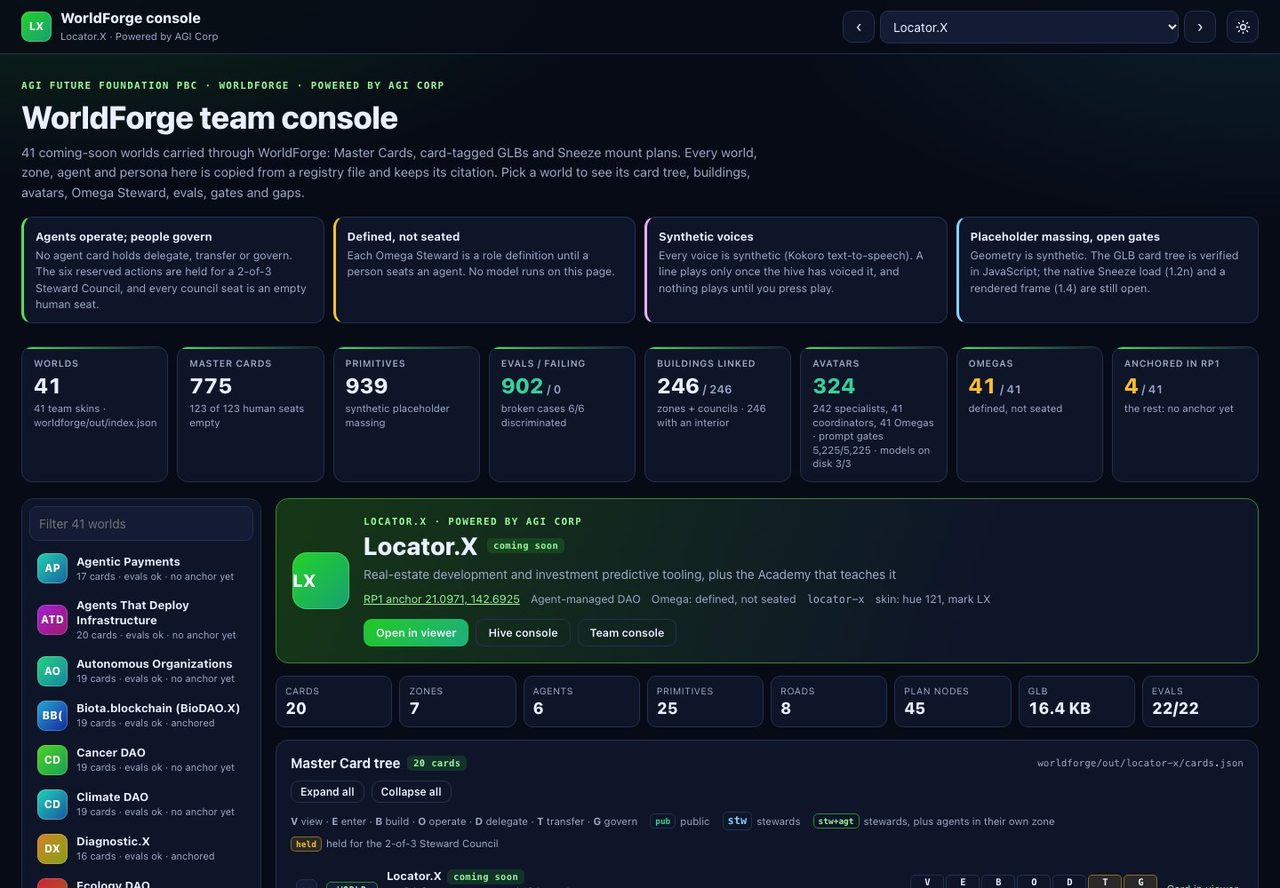
The WorldForge team console: a dark dashboard with network totals across the top, a list of worlds on the left and the Locator.X card with its counts and Master Card tree
Visual: worldforge/out/stills/console.jpg

Facts

Facts for this section, each with its source
FactValueSource
World swarms41 as readagents/swarms/*.json (every file except agi-corp.json)
Specialist agents242 as readsum of agents[] across agents/swarms/<slug>.json; agrees with the SWARMS field of the latest beat in evidence/heartbeat.log
Team sizes38 worlds with 6 specialists, 2 with 5, 1 with 4 as readlen(agents[]) per agents/swarms/<slug>.json
Coordinators and concierge41 coordinators + 1 concierge as readagents/swarms/agi-corp.json coordinators[], concierge
Swarm evals369 of 369 passing (9 per world) as readagents/swarms/<slug>.json evals[]
Routing cases170; mean accuracy 0.995; lowest 0.8 (autonomous-organizations, 5 cases) as readagents/swarms/<slug>.json routing
Mean router calls per turn1.22 (range 1 to 1.25) as readmean of routing.meanLlmCalls across the 41 world swarms
Concierge routing41 of 41 cases, accuracy 1 as readagents/swarms/agi-corp.json routing
Redactions in the PII eval turns82 (2 per world) as readagents/swarms/<slug>.json evals[name=PII redacted in middleware].detail
Handoff limit3 per turn as readagents/fabric/router.mjs MAX_HANDOFFS
Forbidden actions7 as readagents/fabric/agent.mjs FORBIDDEN_ACTIONS
Actions reserved for people6: governance.final_vote, charter.amend, treasury.transfer, proposal.enact, windfall.distribute, steward.appoint re-readworlds/PBC.json reserved_for_humans

Not done yet

  • No language model runs any agent; every agent is a deterministic stub that answers with its role.
  • The LangGraph and Sentient adapters are design only and have never been executed.
  • The seven forbidden actions are inherited unchanged from the vendored mentor fabric (dial setpoints, learner profiles, certification); world-specific forbidden actions beyond the six reserved actions are not defined at the swarm layer.
  • Routing is measured on 170 generated zone questions, not on real visitor traffic; none has been measured.
  • PII redaction is pattern-based (five US-shaped formats); personal names and free-text identifiers are not detected.

Metaprompts and the gates that hold them

Prompts are generated from the registries, tested like code, and the test suite is itself tested with prompts built to fail.

No model runs in this project, so a prompt here is a text artifact the registries produce, not something a person types. agents/metaprompt.mjs reads each world's spec, the charter (worlds/PBC.json), the built swarm and the middleware's own constants, and writes agents/prompts/<slug>.json. Each world gets a team charter that the whole swarm shares, a coordinator prompt carrying the routing table, one prompt per specialist (its zone, its role, its cited source and the peers it can hand off to), and a steward brief for every room console in the world's deep build. One more prompt serves the AGI Corp Concierge. That makes 571 prompts: 41 team charters, 41 coordinators, 242 specialists, 246 room-console briefs and 1 concierge. They run from 2,232 to 3,363 characters against a cap of 6,000.

Every prompt ends in the same common block: the world's name, umbrella, status and tagline; the management model ("Agent-managed DAO - agents operate, people govern"); what agents handle and what humans hold; the six reserved actions with the instruction to answer "Held for the Steward Council" and name the action; the seven forbidden actions; the five read-only surfaces; the rule to cite a source beside every claim; a refusal to ask for, store or repeat personal data; the not-advice line; and the world's known gaps, under the heading "do not fill these by invention".

evalPrompt in agents/metaprompt.mjs is the gate. Nine checks apply to every prompt, a tenth to every world prompt, and three more to every agent prompt; they are listed below. The last one is the subtle one. The coordinator routes on each specialist's keywords; if a specialist's own prompt never contains those words, it would be routed to on grounds it was never told about, and the two prompts would have drifted apart. The gate catches that drift before any model sees either prompt. All 6,435 checks across the 571 prompts pass.

A strict suite that passes everything proves little, so the suite is tested too. selfTest takes a good specialist prompt (the first specialist of Locator.X) and builds four broken copies: the umbrella dropped, treasury.transfer renamed, the source citation removed, and an email address appended. Each must fail exactly one check, its own. All four do. That is the difference between a suite that is strict and one that discriminates.

Each world also gets a spec metaprompt: the prompt that would regenerate worlds/<slug>/spec.json from the founder's one-line focus under the rules in worlds/SPEC.md. For 13 worlds the focus is set and the metaprompt is ready. For the other 28, the series worlds, the slot reads "<NOT SET - a founder action; do not invent one>" and the metaprompt is marked not ready rather than filled with a guess. Advisors get no prompt at all, by contract: they are scripted guides, not AI models.

  • Carries the umbrella, "Powered by AGI Corp".
  • Lists every one of the six reserved actions, and says they are held for the Steward Council.
  • Lists every one of the seven forbidden actions.
  • States the management model and refuses personal data.
  • Carries the not-advice line, word for word.
  • Is at most 6,000 characters and contains no PII, API-key, private-key or wallet-address shaped strings.
  • Names the world and its status (world prompts).
  • Cites the agent's own source, names its zone, and contains every routing keyword the coordinator uses for it (agent prompts).
The WorldForge team console: a dark dashboard with network totals across the top, a list of worlds on the left and the Locator.X card with its counts and Master Card tree
Visual: worldforge/out/stills/console.jpg

Facts

Facts for this section, each with its source
FactValueSource
Prompts571 re-readagents/prompts/index.json totals.prompts
Prompts by kind41 team charters, 41 coordinators, 242 specialists, 246 room-console briefs, 1 concierge as readagents/prompts/*.json agents[].kind
Prompt checks6,435 of 6,435 passing as readagents/prompts/*.json evals[].checks
Failing prompt evals0 re-readagents/prompts/index.json totals.failing
Length cap6,000 characters (observed 2,232 to 3,363) re-readagents/prompts/index.json max_prompt_chars; lengths of agents/prompts/*.json agents[].text
Broken-prompt self-test4 of 4 fail exactly their own check as readagents/prompts/index.json self_test
Spec metaprompts awaiting a founder focus28 of 41 re-readagents/prompts/index.json totals.spec_metaprompts_awaiting_focus
Read-only surfaces an agent may read5 as readagents/fabric/agent.mjs READ_SCOPES

Not done yet

  • No model has run any of these prompts; they are reviewable text with a test suite.
  • The gates check that required text is present, not how a model behaves: a model could still ignore a refusal it was given. Behavioural evals against a live model do not exist yet.
  • 28 spec metaprompts wait for a focus the founder or stewards have not set; those worlds' specs cannot be regenerated until then.
  • The broken-prompt self-test runs on one world's first specialist (Locator.X), not on every world.

Avatars bound to agents

447 avatars, each tied to its Master Card and to a swarm id, a hive record or a scripted advisor record, with a gated persona prompt where one is allowed, a short intro that says the voice is synthetic, and one of six validated models.

Counts written from the registries when this page was built: the voicing and beat counts in this section are read from worldforge/out/voices/manifest.json#totals; worldforge/out/avatars/index.json#totals; agents/hive/index.json#totals; agents/hive/dialogues.json#totals and evidence/heartbeat.log, not from the explainer text; the explainer's earlier wording is kept in worldforge/whitepaper/out/build.json under rebuilt.

worldforge/avatars.mjs writes the avatar registry, worldforge/out/avatars/index.json: one row for every agent-like card in the 41 worlds. There are 447 rows: 242 specialists, 41 coordinators, 123 advisors (a Host Advisor, a Steward Liaison and an Alignment Advisor in every world) and 41 Omega Stewards. The registry says of itself that every name, role, zone and citation is read from the WorldForge cards, the swarm, the advisor records and the hive registry, and that nothing is invented.

Each row carries a binding block that says what the avatar speaks for (summarised below). Every row also copies the seven-right permission table from its card: view, enter, build, operate, delegate, transfer and govern. Agents hold operate inside their own zone only; build and delegate sit with the stewards, and transfer and govern with the steward quorum. Coordinator rows take their position from the coordinator card's Volum and derive their facing from the line between the plaza centre and the card centre, because the card itself stores no facing.

Specialists, coordinators and Omegas get a persona prompt; there are 324. Each is a persona layer on top of the house metaprompt, which is reproduced unchanged beneath it. The layer states that the speaker is an agent with a synthetic voice, not a person; names the avatar id, the model file, the tint and the Kokoro voice; names the card; copies the permission table and the reserved actions; and gives the greeting. Each persona prompt passes every evalPrompt gate plus the avatar gates: it says it is an agent with a synthetic voice, it carries the seven-right table from its card, it names its avatar id and card, and for an Omega it says "defined, not seated". That is 16 gates for a coordinator or specialist and 17 for an Omega: 5,225 gates, all passing.

Every row has a 21 to 25 word intro that itself says the voice is synthetic. A specialist says, for example: "I am the Buyer Agent for Agentic Payments, in Transaction Desk. I draft and check; people decide. You are hearing a synthetic voice." An advisor ends: "Scripted guide, synthetic voice: not an AI model, not a person." Voices are drawn from a pool of 27 Kokoro voices by hashing the avatar id. The registry stores only the expected audio path, never a voiced flag; viewers check for the file when the page loads and otherwise fall back to the browser's speech, labelled synthetic.

The models are six high-resolution GLBs, one per role, in worldforge/out/assets/avatars: specialist, coordinator, omega, host, liaison and alignment. They are stylised, static and rig-free, 1.8 m tall (the Omega 2.1 m), with 2048-pixel body fabric textures in neutral grey that each world tints with its brand hue. Together they hold 99,972 triangles in 12,903,896 bytes, and the Khronos glTF validator reports no errors, warnings, infos or hints on any of the six. The registry runs 21 checks per world (861), catches 28 of 28 deliberately broken fixtures, and passes 3 reporter self-tests: 892 evals, none failing.

  • Specialist: its swarm id (for example agentic-payments.buyer-agent), its metaprompt file and id in agents/prompts/<slug>.json, and its fabric node.
  • Coordinator: the coordinator card coordinator:<slug>, the swarm's coordinator id and its metaprompt.
  • Omega Steward: the hive record omega.<slug> and its metaprompt agents/hive/prompts/<slug>.md; no swarm.
  • Advisor: only its scripted record in agents/advisors/<slug>.json; no swarm, no metaprompt, no persona prompt.
Six white avatar role models in front and back views: specialist, coordinator, Omega with halo, host, liaison and alignment
Visual: worldforge/out/assets/avatars/preview.jpg

Facts

Facts for this section, each with its source
FactValueSource
Avatars447 re-readworldforge/out/avatars/index.json totals.avatars
By kind242 specialists, 41 coordinators, 123 advisors, 41 Omegas as readworldforge/out/avatars/index.json totals
Persona prompts324 (advisors have none by contract) re-readworldforge/out/avatars/index.json totals.persona_prompts
Persona prompt gates5,225 of 5,225 passing (16 per coordinator or specialist, 17 per Omega) re-readworldforge/out/avatars/index.json totals.prompt_gates; worldforge/out/avatars/prompts/<slug>.json prompts[].gates
Persona prompt length3,371 to 5,363 of 6,000 characters as readworldforge/out/avatars/prompts/<slug>.json prompts[].chars
Registry evals892 (861 registry checks, 28 broken fixtures caught, 3 reporter self-tests), 0 failing as readworldforge/out/avatars/index.json totals
Voice pool27 Kokoro voices, all 27 used across the rows as readworldforge/out/avatars/index.json voice_pool; rows[].voice.id
Intro length21 to 25 words as readworldforge/out/avatars/index.json rows[].intro.words
Avatar models6 GLBs, 99,972 triangles, 12,903,896 bytes as readworldforge/out/assets/avatars/index.json totals
Validator result0 errors, 0 warnings on all 6 (gltf-validator 2.0.0-dev.3.10) as readworldforge/out/assets/avatars/validation.json

Not done yet

  • The avatars are static and rig-free: no animation, lip-sync or gesture.
  • No model runs the persona prompts; they are reviewable text with a test suite.
  • There is one model per role, not per agent; agents of the same role differ only by tint, name and voice.
  • 247 of the 406 non-Omega intros are not voiced yet: 46 of 123 advisors and 201 of 242 specialists (worldforge/out/voices/manifest.json).
  • The avatar registry's 892 evals are run by worldforge/avatars.mjs but are not a field in the deploy/evals.sh heartbeat.
  • Nothing is mounted in Sneeze; today the avatars are seen in the browser viewer (worldforge/viewer.html) and the consoles.

The Omega Hive: 44 stewards, defined and not seated

Every Omega Steward has a grounded persona with cited sources, a distinct synthetic voice, four spoken lines, a metaprompt, six cited answers and one handoff, and none of them is seated.

Counts written from the registries when this page was built: the voicing and beat counts in this section are read from worldforge/out/voices/manifest.json#totals; worldforge/out/avatars/index.json#totals; agents/hive/index.json#totals; agents/hive/dialogues.json#totals and evidence/heartbeat.log, not from the explainer text; the explainer's earlier wording is kept in worldforge/whitepaper/out/build.json under rebuilt.

An Omega Steward is the steward agent role defined for each company in agents/advisory/omega_agents.json. There are 44: one for each of the 41 WorldForge worlds, plus AGI Corp Hub, Cognition.X and SmartCiti.X. agents/hive.mjs gives each one a persona, a voice, four spoken lines and a persona-bound metaprompt, and writes them to agents/hive/index.json and agents/hive/prompts/<world>.md. All 44 records say seated: false. An Omega stays "defined, not seated" until a person seats an agent, and its metaprompt tells it never to seat itself or any other agent. Names are role titles, never human names, and no persona imitates a real person.

Each persona has a temperament, a style, values and refusals, assembled from the world's own records: the corporation kind, the spec's focus or tagline, its zones, its service cards and its DAO record. Every source is cited in grounded_in as <file>#<field>, 358 citations in all, and an eval checks that each cited field exists and is not empty. Locator.X's Omega, for example, is "attentive and concrete about its tagline" and speaks in "short, plain sentences" that name its zones and always say who decides. Every persona shares four values: people decide; stewards decide by 2 of 3 signed votes; probe scores are reported exactly as measured; quotes are drafted with every term left null.

Every Omega refuses 11 actions: the six reserved for people, plus set_price, accept_equity, accept_crypto, issue_invoice and move_funds. Its metaprompt adds eight never-rules from its Omega record: no price or rail in a quote; no invoice or payment request, including an HTTP 402 request to another agent; no equity, crypto or signed agreement; no wallet address, key or credential; no engagement marked paid or closed; no installer run without DRY=1, no publishing on RP1's Earth, no land claimed; no record edited to raise a probe score; no legal, tax, financial or investment advice. The metaprompt also says who decides each kind of request: the Steward Council by 2 of 3 Ed25519-signed votes for terms, invoices and failed probes; the council, the founder and counsel for switching a payment rail on; the founder alone for publishing on RP1's Earth.

Each Omega has four lines of at most 25 words: greet, role, boundary and services. The greeting discloses the voice ("You are hearing a synthetic voice; I am an agent, not a person"), and the boundary line names one reserved action it will never take. agents/hive_dialogues.mjs then writes agents/hive/dialogues.json: answers to six fixed visitor questions and one handoff for every Omega, 264 answers and 44 two-turn handoffs carrying 1,510 citations. Every number spoken must appear in a cited record; probe answers report the recorded scores exactly; the visit answer gives the RP1 installer's dry-run status and says publishing is the founder's call. When a world lists no service card for a request, its Omega names a world that does and hands the visitor to that world's Omega, whose turn is spoken in its own voice. The 44 handoffs reach 18 different worlds, and no handoff carries money, a decision or a reserved action.

The Omega Hive console (consoles/hive/index.html) shows each Omega in a drawer with an Ask panel: the six questions as buttons, each answer with its citations and a Play button, and the handoff as a two-turn exchange. The hive is held by 12 evals in agents/hive.mjs and the dialogues by 15 in agents/hive_dialogues.mjs; the latest heartbeat reports 0 failing for both.

  • What do you look after?
  • Who decides here?
  • What will you never do?
  • How do I get a service here?
  • How is this company measured?
  • Can I visit this world?
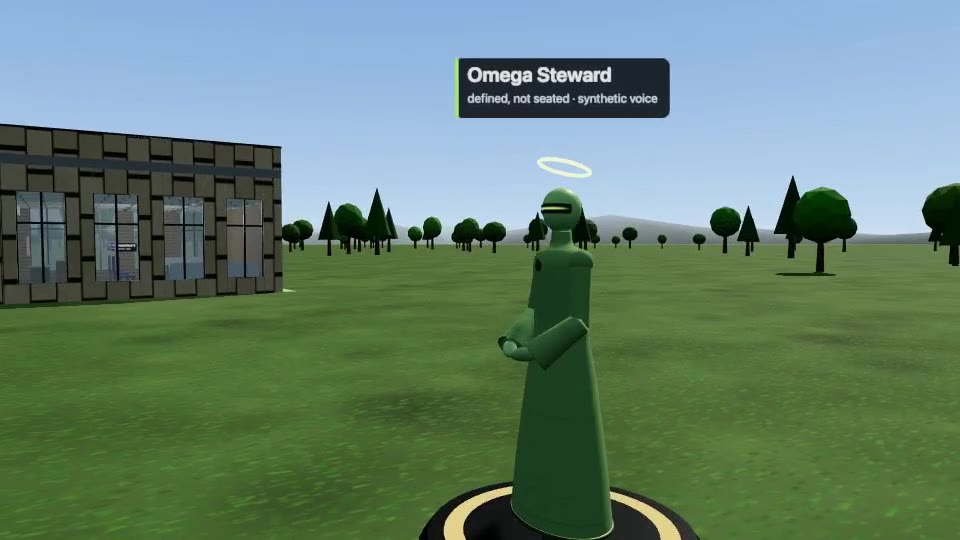
An Omega Steward figure in dark green with a halo, labelled defined, not seated, synthetic voice, standing beside a building
Visual: worldforge/out/stills/viewer-omega.jpg

Facts

Facts for this section, each with its source
FactValueSource
Omega Stewards44 (41 WorldForge worlds + AGI Corp Hub, Cognition.X, SmartCiti.X) re-readagents/hive/index.json totals.omegas; omegas[].world compared with worldforge/out/index.json worlds
Seated0 of 44 as readagents/hive/index.json omegas[].seated
WorldForge Omega cards41, each status "defined, not seated", seated_agent null as readworldforge/out/<slug>/cards.json (kind omega)
Persona citations358 as readsum of agents/hive/index.json omegas[].persona.grounded_in
Refusals per persona11 as readagents/hive/index.json omegas[].persona.refuses
Synthetic voices27 distinct Kokoro voices across the 44 Omegas re-readagents/hive/index.json totals.voices
Spoken lines176 lines, 173 spoken re-readagents/hive/index.json totals.lines, totals.spoken
Dialogues264 answers, 44 handoffs (88 turns), 1,510 citations as readagents/hive/dialogues.json totals
Handoff targets18 different worlds as readagents/hive/dialogues.json omegas[].handoff.target_service.world
Evals12 hive evals + 15 dialogue evals, 0 failing in the latest beat as readagents/hive.mjs, agents/hive_dialogues.mjs; HIVE and DIALOGUES fields of evidence/heartbeat.log

Not done yet

  • No Omega is seated, and no model runs any of them.
  • The Ask panel plays pre-written, cited answers to six fixed questions; it does not take free-text questions.
  • 3 of 176 hive lines have no audio: rendered at 11.54 s, 12.14 s and 12.57 s, they run past the 11.5 s limit (agents/hive/voices/manifest.json).
  • 170 of 352 dialogue lines are voiced (agents/hive/dialogues.json).
  • The service cards the Omegas route to are listed, not live, and every payment rail is off (latest beat, ADVISORY field: 3 rails, 0 enabled).
  • Publishing any world on RP1's Earth is the founder's call; no Omega publishes.

Synthetic voices: what is voiced and what is not

Every voice is Kokoro text-to-speech run locally, every line says it is synthetic, and the manifests list only what was actually rendered.

Counts written from the registries when this page was built: the voicing and beat counts in this section are read from worldforge/out/voices/manifest.json#totals; worldforge/out/avatars/index.json#totals; agents/hive/index.json#totals; agents/hive/dialogues.json#totals and evidence/heartbeat.log, not from the explainer text; the explainer's earlier wording is kept in worldforge/whitepaper/out/build.json under rebuilt.

All audio in this part of the project comes from Kokoro v1.0 (kokoro-onnx), an Apache-2.0 text-to-speech model that runs locally. No account, key or credit is involved and nothing is sent anywhere. agents/hive.mjs lists 28 English Kokoro voices and leaves one out, am_santa, because it is a character voice and an Omega imitates no one. That leaves a pool of 27. Omegas take voices at a stride of 10, which shares no factor with 27, so neighbouring Omegas sound different and every voice is used; all 27 appear across the 44 Omegas. Avatar rows pick from the same pool by hashing the avatar id, and all 27 appear across the 447 rows.

There are three bodies of audio, and each has its own record (listed below). The hive's own lines are nearly complete; the dialogues and the avatar intros are a fraction done. All of it is stored the same way: mono AAC at 48 kbps and 24 kHz in an .mp4 container with faststart, loudness-normalised by ffmpeg in two passes to -16 LUFS integrated and -1.5 dBTP true peak.

Three contracts keep the record honest. First, a line counts as spoken only when its file exists and the manifest shows it was rendered from the same words, voice and speed; a hive line must also run 11.5 seconds or less, and a dialogue line is fitted to 18 seconds. Second, the avatar registry stores only the expected audio path, never a voiced or exists flag, because such a flag would go stale as lines are rendered; viewers check for the file at view time and otherwise use the browser's speech with the row's pitch, rate and language, labelled synthetic voice. Third, the voice manifest lists only lines actually rendered, so a missing entry means not voiced. When a line's text or voice changes, its entry is dropped and its file deleted before it is rendered again, so a viewer never plays an outdated line.

Every line discloses itself. The avatar intros end with "You are hearing a synthetic voice", the Omega greeting adds "I am an agent, not a person", and the voicing script skips and reports any row whose intro does not say so. Nothing plays on its own: the console builders check that no player autoplays and that playback starts only when a person presses play.

Rendering is polite to the machine it shares. The intro renderer (worldforge/voice/voice_intros.py) uses at most two threads, is time-boxed and resumable, and sleeps through the other team's film render windows. Hive audio is rebuilt from the registry and never committed; the repository ignores agents/hive/voices/.

  • Omega lines (agents/hive/index.json): 176 lines, 173 spoken, 1,413.4 seconds in total.
  • Omega dialogues (agents/hive/dialogues.json): 352 lines (264 answers and 88 handoff turns), 170 spoken.
  • Avatar intros (worldforge/out/voices/manifest.json): 159 lines voiced (41 coordinators, 41 specialists and 77 advisors), 1,510.6 seconds in total.
Frame from the recorded omega steward clip of Cancer DAO in the WorldForge viewer
Visual: worldforge/review/out/clips/cancer-dao-omega.mp4 (a frame of the recorded clip)

Facts

Facts for this section, each with its source
FactValueSource
EngineKokoro v1.0 (kokoro-onnx), Apache-2.0, local as readagents/hive/index.json voice_engine; worldforge/out/voices/manifest.json engine
Voice pool27 of 28 English voices (am_santa excluded) as readagents/hive.mjs ENGLISH_VOICES, VOICE_POOL; worldforge/out/avatars/index.json voice_pool
Omega lines spoken173 of 176 as readagents/hive/index.json totals
Omega line audio1,413.4 s as readsum of agents/hive/index.json omegas[].lines[].seconds for lines with audio
Dialogue lines spoken170 of 352 from registryagents/hive/dialogues.json#totals.spoken (written from the registry when this page was built)
Avatar intros voiced159 (41 coordinators, 41 specialists and 77 advisors), 1,510.6 s from registryworldforge/out/voices/manifest.json#totals (written from the registry when this page was built)
Audio formatmono AAC 48 kbps, 24 kHz, .mp4; -16 LUFS, -1.5 dBTP as readworldforge/out/voices/manifest.json settings
Hive line length limit11.5 s as readagents/hive.mjs (fresh-line test, same limit as agents/hive_voice.py)

Not done yet

  • No model speaks live; every voiced line is a pre-rendered file of scripted text.
  • 247 of 406 non-Omega avatar intros are not voiced: 46 of 123 advisors and 201 of 242 specialists.
  • 182 of 352 dialogue lines are not voiced.
  • 3 Omega lines (two services lines and one role line) still run past the 11.5 s limit and carry no audio.
  • Hive audio is not in the repository; a fresh checkout has none until it is rebuilt locally.

Team consoles: static pages, stamped against their sources

Each console is a single self-contained page built from the registries; it runs no model, and a stamp shows when it has fallen behind what it reads.

The consoles are where a person looks at the agents. Each is one static HTML page written by a Python builder from the registries. No page loads a remote script, stylesheet or font, and none runs a model. Every page carries a source stamp, a hash over the builder and exactly the data it was built from; the builder's --check recomputes it, so a console built before a swarm, prompt or registry changed reports STALE instead of quietly showing yesterday's agents. The WorldForge and hive builders also check that two builds are byte-identical, that no private repository name or stray email address reaches the page, that nothing plays until a person presses play, and that the page works at phone width in light and dark themes.

The WorldForge console (consoles/worldforge/index.html) shows the 41 worlds, each in its own team skin (hue, mark and lockup from worlds/generated/teams/<slug>.json), and all 939 Master Cards with their permission matrices. Rights held by the steward quorum render as "held"; each council shows exactly three empty human seats; every Omega card reads "defined, not seated". When the avatar registry exists the console reads it and checks it against the cards. It links to the viewer at a given world and card, to the hive console and to the teams console, and its builder runs 31 evals.

The Omega Hive console (consoles/hive/index.html) gives each of the 44 Omegas a drawer: persona chips, voice, the four lines with Play buttons, the full metaprompt, the refusals as locked chips, the RP1 dry-run line, routes and probes, and the Ask panel. Emblems are procedural hex cells drawn from the world slug; there are no faces and no pictures on the page. The latest heartbeat beat is embedded after redaction.

Four more consoles sit under agents/ (summarised below). Two of them run the project's own code in the page rather than describing it. In the agent console, "Try a turn" inlines the vendored middleware and pbcGuard verbatim, so a typed turn is routed, redacted and contained by exactly the code the swarm evals run. In the DAO console, "Try a decision" lets a visitor watch an agent's enact attempt be held while two steward votes enact. Both say plainly that they are rehearsals: state lives in the visitor's browser, the seats are scripted, and no treasury exists to move.

  • agents/console.html: every world's swarm, prompts, advisors and evals, with "Try a turn" through the real middleware.
  • agents/teams.html: 43 team skins over 4,300 scaffold worlds and 20 custom spaces, each scaffold with no focus, name or location given by a person.
  • agents/dao.html: management teams, proposal pipelines, steward seats and decision logs, with "Try a decision".
  • agents/comms.html: one channel per world; an @mention routes through that channel's router, and an agent asked to enact or transfer answers "Held for the Steward Council".
The WorldForge team console: a dark dashboard with network totals across the top, a list of worlds on the left and the Locator.X card with its counts and Master Card tree
Visual: worldforge/out/stills/console.jpg

Facts

Facts for this section, each with its source
FactValueSource
WorldForge console scope41 worlds, 939 cards, 31 builder evals as readconsoles/worldforge/build_worldforge_console.py; worldforge/out/index.json totals
Hive console scope44 Omega drawers, each with an Ask panel as readconsoles/hive/build_hive_console.py; agents/hive/dialogues.json
Scaffold worlds in the teams console4,300 across 43 teams over 20 custom spaces as readworlds/generated/index.json totals
DAO rehearsal43 DAO teams, 352 seats, 155 open proposals, 44 agent attempts held as readDAO field of the latest beat in evidence/heartbeat.log
Comms41 channels, 529 messages, 41 held attempts, 123 human seats as readCOMMS field of the latest beat in evidence/heartbeat.log
Console freshness in the latest beatCONSOLE, TEAMS, DAOC, COMMSC and HIVEC all current as readevidence/heartbeat.log, beat at 07:29:33

Not done yet

  • The consoles are rehearsals: steward queues, comms messages and DAO decisions live only in the visitor's browser, with no shared record of human decisions behind them.
  • The WorldForge console's --check is not a field in deploy/evals.sh, so the heartbeat does not catch it going stale.
  • The consoles are served by the local static server; nothing is deployed.
  • The scaffold worlds in the teams console are templates; none has been promoted to a real world by a steward-written focus.

Heartbeat, evals and stop rules

One line of evals, appended to a log on a cadence, that stops itself rather than keep beating over a broken build.

Moved since this explainer was written: Beats logged: the text says 92 (69 GREEN, 23 RED), evidence/heartbeat.log (beats logged when this page was built) now reads 101; WorldForge evals in the latest beat: the text says 1,025, 0 failing, worldforge/out/index.json#totals.evals now reads 1,066. The prose below keeps the explainer's wording; the registry value is the current one.

Counts written from the registries when this page was built: the voicing and beat counts in this section are read from worldforge/out/voices/manifest.json#totals; worldforge/out/avatars/index.json#totals; agents/hive/index.json#totals; agents/hive/dialogues.json#totals and evidence/heartbeat.log, not from the explainer text; the explainer's earlier wording is kept in worldforge/whitepaper/out/build.json under rebuilt.

deploy/evals.sh runs every check in the project and prints one line: the time, GREEN or RED, then 50 labelled fields from GLB to DISK. It exits 0 only when everything is green. Most fields are a builder's own summary line or the result of its --check. The fields that concern agents and the hive are SWARMS, LEDGER, PROMPTS, CONSOLE, TEAMS, DAO, DAOC, SERVICES, ADVISORY, ADVISORS, COMMS, COMMSC, HIVE, HIVEC, WORLDFORGE and DIALOGUES.

deploy/heartbeat.sh runs evals.sh on a cadence (by default every 5 minutes for 45 minutes, or once), appends every line to evidence/heartbeat.log, and stops with exit code 2 on any of three conditions: RED twice in a row, because a second failure means the build is broken rather than flickering; less than 500 MiB of free disk, because the next rebuild would fill the volume mid-write; and a local server that is down and cannot be started, because then there is nothing to measure. Its rule is "Silence is not evidence": a beat that could not run is written as RED with the reason, never skipped.

When this explainer was written the log held 92 beats: 69 GREEN and 23 RED, with 5 STOP lines where two REDs came in a row. The two most recent show the loop working. At 07:26:20 the beat was RED because one console had gone stale (ROBOPITCH: "robotics pitch was built from 2d537efab0450e84, sources are now c0dad6e723d5d37c"). It was rebuilt, and the 07:29:33 beat was GREEN. The agent fields of that beat are quoted below; the beat this page cites is excerpted beside them.

Three caveats sit in that same line, and they are part of the record. SERVE reads "skipped (sandbox blocks local binding), files present": the sandbox refused the local server, so the beat checked the files it would have served instead. The NETWORK check was added to evals.sh after that beat, so the latest logged line carries 49 checks rather than 50. And the GLB field's 667 validated models are the my-fabric worlds' models; the six avatar models are validated separately (worldforge/out/assets/avatars/validation.json).

Freshness and discrimination are the two habits that run through all of this. Consoles and registries carry a stamp or a --check mode that recomputes what they were built from, and the eval suites are fed deliberately broken inputs to prove it can fail: four broken prompts, 28 broken avatar fixtures, broken console fixtures. A suite that cannot fail tells you nothing; these are shown failing on purpose before they are trusted to pass.

  • SWARMS: 41 swarms, 242 agents + 41 coordinators + 1 concierge; 0 failing evals
  • PROMPTS: 41 worlds, 571 prompts, 28 spec metaprompts awaiting a founder focus; 0 failing prompt evals
  • LEDGER: 284 entries (41 worlds), 0 failing checks
  • HIVE: 44 omegas, 44 personas, 27 voices, 176 lines (173 spoken), 0 failing hive evals
  • DIALOGUES: 44 omegas, 264 answers, 44 handoffs, 50 spoken, 0 failing dialogue evals
  • WORLDFORGE: current: 41 worlds, 939 cards, 1025 evals, 0 failing
  • ADVISORY: 5 example engagements, 3 rails (0 enabled), 44 omega agents, 0 failing advisory evals
Excerpt of the beat this page cites, from evidence/heartbeat.log (pinned when the page was built).

Facts

Facts for this section, each with its source
FactValueSource
Labelled fields in one eval line50 (GLB to DISK) as readdeploy/evals.sh (final echo line)
Stop rulesRED twice in a row; disk below 500 MiB; server down and unstartable as readdeploy/heartbeat.sh
Default cadenceevery 5 minutes for 45 minutes as readdeploy/heartbeat.sh
Beats logged92 (69 GREEN, 23 RED) now 101evidence/heartbeat.log (lines beginning with a time and GREEN or RED)
STOP lines5, each for RED two beats in a row as readevidence/heartbeat.log
Latest beat07:29:33 GREEN, preceded by 07:26:20 RED (ROBOPITCH stale) as readevidence/heartbeat.log
WorldForge evals in the latest beat1,025, 0 failing now 1,066WORLDFORGE field of evidence/heartbeat.log; worldforge/out/index.json totals.evals

Not done yet

  • The heartbeat is a local process: no hosted monitoring, alerting or uptime record exists.
  • Not every registry is a heartbeat field: the avatar registry's 892 evals, the voice manifest check (worldforge/voice/voice_intros.py --check) and the WorldForge console check run in their own builders, not in deploy/evals.sh.
  • The latest logged beat predates the NETWORK check and ran with SERVE skipped under the sandbox.
  • my-fabric/spaces.py --check and my-fabric/scenes.py --check take minutes each and run at reviews, not every beat.
  • The log records times of day without dates.

Deep explainer

Environments, assets and the stack

Written by the explainer agents from the registries on 2026-10-12. Facts marked re-read were re-read from their registry when this page was built; now N marks a value that has since moved; as read is the agent's reading of a source this build does not parse.

Buildings: 246 shells, 246 fit-outs and one texture library

Every zone in every world, the Steward Council hall included, stands inside a textured building whose door lines up with the room behind it.

Each world's spec names its zones. The deep-world builder turns every zone into a room 10 m wide, 8 m deep and 3.6 m high, and my-fabric/spaces.py wraps that room twice: an exterior shell (a facade with a window grid and mullions, an entrance portal, a plinth with steps, a roof slab with parapet and rooftop plant, and a sign band) and an interior fit-out (a patterned floor with an inlay border, wall panelling, skirting and a dado rail, a coffered ceiling with light panels, and the furniture and fixtures of the room's kind). Across the 41 worlds that makes 246 exteriors and 246 interiors. The count matches WorldForge's 246 zones because the Steward Council that every spec lists gets a hall too, even though its card is the council card, not a zone card.

A room's kind comes from its own purpose text, matched by build_deep.kind_of() against seven kinds: forum (113 rooms), lab (74), ops (37), studio (13, also the fallback), desk (4), clinic (3) and library (2). Each kind has its own style recipe: a bonded stone facade with veining for the forum, bolted white panels for the lab, brick and mortar for the library, small glossy tiles for the clinic. Every texture is procedural, made with numpy and Pillow from a fixed seed, so the same registries always produce the same bytes. No building is modelled on a real one.

The textures are PBR sets: albedo, a normal map, and an ORM map that packs occlusion, roughness and metalness into one image. The hero facade of each kind is 2048 px; floor, wall and ceiling are 1024 px. That is 84 library textures (7 kinds, 4 surfaces, 3 maps), 21 of them at 2048 px. Each set is embedded once, in its kind's two hero models (14 shared models, 10,434,416 bytes), and every room of that kind in every world points at those two models. A room's own GLB keeps only what is unique to it: the sign band lettered with the zone's name (246 sign textures), the world's accent colour, the console and the placard. All room models together come to 2,151,432 bytes, and the whole layer to 12.6 MB. The sets are embedded rather than linked because a GLB that points at an external image fails this repository's validator loop, and the RP1 exporter and publish bundle carry .glb files only.

The doors are aligned by construction and then checked. All 246 exteriors carry the same opening: 2.4 m wide and 2.8 m high, centred on the room's front wall at (0, 0, 4.0) in the model frame. The spaces check asserts that each shell and fit-out is a child node at its room's origin with no rotation or scale, and that every room's door faces the plaza centre. It casts rays through the doorway for each of the seven kinds: they must pass clear through shell, fit-out and room, while rays beside the doorway must hit the facade. It also checks that every sign shows its zone's registry name, that no texture exceeds 2048 px, that a rebuild is byte-for-byte identical, and that every spaces model passes the Khronos validator with 0 errors and 0 warnings. Each WorldForge zone card links its building through a building block, and the buildings_resolve eval checks that link.

A generated building in the WorldForge viewer: a dark shell signed Master Dashboard, its glass front showing the fitted interior, with planters on a paved forecourt at dusk
Visual: worldforge/out/stills/viewer-building.jpg

Facts

Facts for this section, each with its source
FactValueSource
Building exteriors246 re-readmy-fabric/worlds/spaces_index.json#totals.exteriors
Building interiors246 re-readmy-fabric/worlds/spaces_index.json#totals.interiors
Zones across the 41 worlds246 re-readworldforge/out/index.json#worlds[].zones (sum)
Rooms by kindforum 113, lab 74, ops 37, studio 13, desk 4, clinic 3, library 2 as readmy-fabric/worlds/spaces_index.json#worlds[].exteriors[].kind (count)
Library textures84 (21 facade maps at 2048 px; 63 floor, wall and ceiling maps at 1024 px) re-readmy-fabric/worlds/spaces_index.json#totals.library_textures, #totals.at_2048, #library[].size
Sign textures246 re-readmy-fabric/worlds/spaces_index.json#totals.sign_textures
Shared hero models14 GLBs, 10,434,416 bytes as readmy-fabric/worlds/spaces_index.json#shared, #totals.shared_bytes
All room models2,151,432 bytes re-readmy-fabric/worlds/spaces_index.json#totals.room_bytes
Spaces layer total12.6 MB re-readmy-fabric/worlds/spaces_index.json#totals.mb
Hero model trianglesexteriors 1,528 to 1,984; interiors 1,392 to 4,588 as readmy-fabric/worlds/spaces_index.json#shared[].triangles
Door opening2.4 m wide (half-width 1.2 m), 2.8 m head, centred at (0, 0, 4.0) as readmy-fabric/worlds/spaces_index.json#worlds[].exteriors[].door
Bundle size before spaces, and the growth budget108.6 MB baseline; 40 MB budget re-readmy-fabric/worlds/spaces_index.json#baseline.bundle_mb; my-fabric/spaces.py BUDGET_MB

Not done yet

  • my-fabric/spaces.py --check takes minutes, so it runs at review time and not on every heartbeat beat. Its last pass or fail is not stored in any registry, so this paper reports none.
  • Every texture is procedural. Nothing is photographed, scanned or taken from a real building.
  • The interiors are generic fit-outs for seven room kinds. They are not designed room by room for each zone's real work.

Forecourts, land and sky

Every building gets a forecourt laid out from one shared kit, and every world stands on its own layered land under a sky chosen from words in its name.

my-fabric/scenes.py lays out a forecourt in front of all 246 buildings from one kit of 19 GLB models (970,660 bytes). Each kit model is written once and linked into every RP1 installer instead of copied. The kit is paving with a 2048 px PBR set, kerbs, steps, trees with a trunk and a layered canopy, planters, low hedges, a lawn, benches, lamp posts with emissive heads, bollards, a bike rack, a wayfinding totem, and one water feature or sculpture for each room kind.

Every building gets the same 40-item plan, read from its footprint and its door. A paved walk runs along the front from the foot of the building's steps, with two short flights up to the plaza's first tier. Side walks edged by kerbs run back along both flanks. Lawns with trees and hedges sit beside them, benches face the walks, and six lamps stand at the steps and the corners, along with planters, bollards, the bike rack, the totem and the kind's feature. These nodes are children of the room's exterior node, in the room's own frame. Any item that would touch a building, the plaza, another model of the world or another item is left out, and the index records the reason. Of 9,840 candidate placements (246 forecourts × 40), 9,092 were placed and 748 were dropped, all for touching another model. The totem names its zone exactly as the spec registry spells it, and the index stores the citation path beside each name.

The lamp heads are emissive, warm white (colour 1.0, 0.85, 0.62), and the stated intent is on from dusk to dawn. The spatial fabric schema has no metadata field on a model node, so that intent lives where a schema can carry it: in the lamp GLB's glTF extras and in the scenes index. No fabric light node was added.

my-fabric/build_env.py gives each of the 41 worlds its own land model and sky model, 82 GLBs in all. The biome is a styling choice made from words in the world's name, slug or tagline. The first rule that matches wins, and the rule and the matched word are recorded for each world. Seven biomes are in use: clinical campus (14 worlds), urban plaza (6), conifer forest (6), industrial yard (5), observatory highland (5), wetland delta (3) and solar mesa (2). The default temperate-park rule matched no world. The land is built in layers that show at the rim of the disc: bedrock, subsoil, topsoil, ground cover, a paved apron with a ring path, water, vegetation, props, and a horizon ring of landforms. That is 357 layers in all, 7 to 9 per world. Locator.X, for example, matched urban plaza on the word "locator". It has a ground-cover disc 326 m in radius, one pond 18.4 m in radius, 40 street trees, 18 blocks, 28 skyline forms on a horizon ring 360 to 470 m out, and a dusk sky dome 600 m in radius with the sun 6° above the horizon. Times of day are spread across the worlds: dusk 17, morning 12, night 6, noon 5, dawn 1.

Frame from the recorded fly-in clip of Cancer DAO in the WorldForge viewer
Visual: worldforge/review/out/clips/cancer-dao-flyin.mp4 (a frame of the recorded clip)

Facts

Facts for this section, each with its source
FactValueSource
Forecourts246 re-readmy-fabric/worlds/scenes_index.json#totals.forecourts
Kit models19 GLBs, 970,660 bytes re-readmy-fabric/worlds/scenes_index.json#totals.kit_models, #totals.kit_bytes
Items in each forecourt plan40 re-readmy-fabric/worlds/scenes_index.json#plan.items
Placements made and dropped9,092 placed; 748 dropped (all: touches another model of the world) re-readmy-fabric/worlds/scenes_index.json#totals.placements, #totals.dropped, #worlds[].dropped[].why
Lamps per forecourt6, emissive; night intent in glTF extras, no fabric light node as readmy-fabric/worlds/scenes_index.json#lighting
Land and sky models41 land + 41 sky re-readmy-fabric/env/index.json#totals.land_models, #totals.sky_models
Biomes in use7: clinical campus 14, urban plaza 6, conifer forest 6, industrial yard 5, observatory highland 5, wetland delta 3, solar mesa 2 as readmy-fabric/env/index.json#biomes
Land layers357 in all; 7 to 9 per world re-readmy-fabric/env/index.json#totals.layers, #worlds[].layers
Time of daydusk 17, morning 12, night 6, noon 5, dawn 1 as readmy-fabric/env/index.json#worlds[].time (count)
Example world environmentLocator.X: urban plaza (word "locator"), 326 m ground disc, 600 m dusk sky dome as readmy-fabric/env/locator-x.json

Not done yet

  • my-fabric/scenes.py --check is also a review-time check. No current pass or fail is recorded in a registry, so none is reported here.
  • 748 planned forecourt items were left out where they would collide. The gaps are recorded, but those forecourts have not been redesigned.
  • The lamps' night-light intent is declared, not executed. No fabric light node exists for them, and no engine has been shown to act on the glTF extras.
  • Biomes are styling choices. They depict no real place, and every layer is procedural.

Civic landmarks, agent avatars and synthetic voices

Each world has a synthetic civic tower for a skyline, and every agent card has a stylised, rig-free body, a tint in its world's colour, and a voice labelled synthetic.

Counts written from the registries when this page was built: the voicing and beat counts in this section are read from worldforge/out/voices/manifest.json#totals; worldforge/out/avatars/index.json#totals; agents/hive/index.json#totals; agents/hive/dialogues.json#totals and evidence/heartbeat.log, not from the explainer text; the explainer's earlier wording is kept in worldforge/whitepaper/out/build.json under rebuilt.

worldforge/landmarks/build_landmarks.py writes one procedural tower per world, 41 GLBs, and generates every texture from scratch. Each root node's extras declare it synthetic and not modelled on a real building. Every tower sits on a 12 × 12 m footprint. Its height comes from a hash rule, 30 + 40·u where u is taken from sha256 of the world's slug, rounded to 0.5 m, so heights run from 30.5 m (Biota.blockchain) to 69.0 m (Aerospace DAO, Series 31). The style follows registry facts. Series worlds get series-setback (28 towers), DAOs whose zones cite the PBC mission get focus-rotunda (6), worlds whose zones cite the founder tracks get track-twist (3), and the rest get platform-prism (4). The facade, glass and stone textures are neutral and shared within each style. A world's brand hue appears only in the fin tint, the crown glow and the plaque, and the plaque carries nothing but the brand-mark letters. Each tower embeds a 2048 px facade set and 1024 px stone, glass and plaque maps. Altogether the towers have 508,339 triangles (8,260 to 27,242 each) and weigh 85,396,200 bytes. The Khronos validator reports 0 errors and 0 warnings on all 41, and its report hashes match the files on disk. Each tower also has a computed placement, north of the plaza, at least 3 m clear of every primitive, road and card volume, with the entrance turned to face the plaza. That placement is a suggestion only: no viewer, fabric or build loads the towers yet.

worldforge/avatars/build_avatars.py writes six role models: specialist, coordinator, omega, host, liaison and alignment. They are stylised agents, not people. They are static and rig-free, stand with their feet at y = 0 facing +Z, and are 1.8 m tall; the omega is 2.1 m with a halo. Each has 15,280 to 18,216 triangles, for 99,972 in all and 12,903,896 bytes. The body fabric carries a 2048 px base colour and normal map, and the ORM, visor, light-bar and emblem maps are 1024 px. The models are neutral grey, and each world tints them by multiplying the body and garment base colour by its brand hue. All six pass the validator with 0 errors and 0 warnings.

The avatar registry binds 447 avatars to their records: 242 specialists (one per agent card), 41 coordinators, 123 advisors and 41 Omegas. The 324 persona prompts pass 5,225 prompt gates with none failing. Advisors speak scripted intros and have no prompt. The registry runs 892 evals with 0 failing, and 28 broken fixtures each fail their own check. In the deep fabrics, 324 avatars stand in place: specialists face their room's door, coordinators the gate road, Omegas the plaza. Every Omega is defined, not seated.

The voices are Kokoro v1.0 (kokoro-onnx, Apache-2.0), run locally with no account and nothing sent anywhere. WorldForge has rendered 159 intro lines (41 coordinators, 41 specialists and 77 advisors), 1,510.6 s in all, normalised to −16 LUFS. The hive has spoken 173 of its 176 Omega lines, from a pool of 27 voices. Every intro says the voice is synthetic. An avatar without a rendered file falls back to a labelled browser voice.

Contact sheet of the 41 civic landmark towers in four rows, each tinted in its world's brand colour
Visual: worldforge/out/assets/landmarks/preview.jpg

Facts

Facts for this section, each with its source
FactValueSource
Civic landmarks41 GLBs, 508,339 triangles, 85,396,200 bytes as readworldforge/out/assets/landmarks/index.json#totals
Landmark heights30.5 m to 69.0 m on a 12 × 12 m footprint re-readworldforge/out/assets/landmarks/index.json#totals.min_height_m, #totals.max_height_m, #footprint_m
Landmark stylesseries-setback 28, focus-rotunda 6, platform-prism 4, track-twist 3 as readworldforge/out/assets/landmarks/index.json#totals.styles
Landmark validation41 files, 0 errors, 0 warnings (gltf-validator 2.0.0-dev.3.10) as readworldforge/out/assets/landmarks/validation.json
Avatar role models6 GLBs, 99,972 triangles, 12,903,896 bytes, rig-free as readworldforge/out/assets/avatars/index.json#totals, #rig
Avatar validation6 files, 0 errors, 0 warnings as readworldforge/out/assets/avatars/validation.json
Avatars bound to records447 (242 specialists, 41 coordinators, 123 advisors, 41 Omegas) as readworldforge/out/avatars/index.json#totals
Persona prompts and gates324 prompts; 5,225 gates, 0 failing; 892 registry evals, 0 failing as readworldforge/out/avatars/index.json#totals
Avatars placed in the deep fabrics447 across 41 worlds, from 6 models from registrymy-fabric/worlds/avatars_mount.json#totals (written from the registry when this page was built)
WorldForge voiced intros159 lines, 1,510.6 s (Kokoro v1.0, local) from registryworldforge/out/voices/manifest.json#totals (written from the registry when this page was built)
Omega Hive voices44 Omegas, 27 voices, 173 of 176 lines spoken as readagents/hive/index.json#totals

Not done yet

  • The landmarks are not placed in any world. worldforge/build.mjs, both viewers, the deep fabrics and the RP1 bundle do not load them; the placements in the index are suggestions.
  • The avatars have no rig and no animation. They stand still.
  • The RP1 publication budget is 2 MiB per model, and the three avatar models in the bundle (2,122,088 to 2,205,748 bytes) are over it. The manifest treats this as a warning, not a blocker.
  • Not every line is voiced: 159 WorldForge intros of 447 avatars, and 173 of 176 hive lines. Nothing speaks live.
  • No Omega Steward is seated. A person must seat an agent before any Omega acts.

One pipeline: generators, glTF 2.0 and a validator on every beat

Every asset is written by a deterministic Python or Node generator, re-checked by that generator's --check mode, and validated against the Khronos glTF 2.0 specification.

Moved since this explainer was written: WorldForge evals: the text says 1,025 (25 per world × 41), 0 failing, worldforge/out/index.json#totals.evals now reads 1,066; World GLBs: the text says 41, 769,296 bytes, 1,103 card-tagged primitives, worldforge/out/index.json#worlds[].glbBytes (sum) now reads 769,448; Heartbeat GLB sweep: the text says 667 GLBs validated, 0 with errors/warnings, evidence/heartbeat.log (GLB field of the beat this page cites) now reads 673. The prose below keeps the explainer's wording; the registry value is the current one.

The files under worldforge/out and my-fabric/worlds/models are generator output, not hand edits. Geometry and textures come from Python 3 builders using numpy and Pillow: spaces.py, scenes.py, build_env.py, build_deep.py, build_landmarks.py and build_avatars.py. The card layer and the registries come from Node builders: worldforge/build.mjs, avatars.mjs, onchain.mjs, and the agent builders under agents/. Each has a --check mode that rebuilds in memory, compares the result byte for byte with what is on disk, runs its evals, and exits 1 when anything is stale or failing. The same registries always produce the same bytes. The spaces and onchain builders both test that directly.

Every model is binary glTF 2.0 (GLB), Y-up, in metres, with its textures embedded so that each file stands alone. WorldForge writes one GLB per world: blockout massing built from one shared unit-cube mesh, in which every node carries its cardId and parentCardId in glTF extras. A native loader can therefore rebuild the Master Card tree without trusting display names. The 41 world GLBs total 769,296 bytes and carry 1,103 tagged primitives. For each world, 25 evals cover unique ids, parents before children, the 48-character name limit, no agent holding a reserved right, the six reserved actions held verbatim for a 2-of-3 quorum, three empty human seats, citations, nothing invented, the GLB parsing, and the GLB card tree matching the cards. That is 1,025 evals, with 0 failing. Six deliberately broken worlds each fail exactly their own check, which shows the suite can tell good from bad.

Validation uses the Khronos glTF-Validator (2.0.0-dev.3.10) on raw bytes with no external resources allowed. The heartbeat runs deploy/evals.sh every five minutes for its window. Its 07:29:33 beat on 2026-10-12 was GREEN: 667 GLBs validated across the my-fabric model folders with 0 errors or warnings, 197 fabrics with 0 missing references or over-long names, and 46 RP1 installers dry-run with 0 failing. Outside that sweep, WorldForge's 42 GLBs (41 worlds plus the shared unit cube) were re-validated for this paper with 0 errors and 0 warnings, and the landmark (41) and avatar (6) reports show the same. The roadmap's figure of "506 glTF models" is an earlier count.

The browser viewers use three.js. worldforge/viewer.html loads three@0.160.0 through an importmap, with GLTFLoader and OrbitControls. It draws each world's buildings, rooms, interiors, sky and avatars, and it falls back to a blockout hall, a gradient sky or a tinted stand-in when a model is missing. It exposes a small recording contract, window.__wfReady and window.__wfShot, for five camera modes: orbit, flyin, building, omega and council. worldforge/review/record.mjs drives that contract in headless Chrome and captures 12 frames a second for 5 s, encoded as 960×540 clips. If the viewer cannot shoot, the recorder exits 1 rather than fake a frame. my-fabric/viewer.html, also three@0.160.0, adds a WebXR button. The walkable family page uses three.js r128.

Inside the Steward Council hall: three purple chairs labelled as empty human seats, with a long table and timber screens
Visual: worldforge/out/stills/viewer-council.jpg

Facts

Facts for this section, each with its source
FactValueSource
WorldForge evals1,025 (25 per world × 41), 0 failing now 1,066worldforge/out/index.json#totals.evals, #totals.failed; worldforge/out/<slug>/manifest.json#evals
Broken worlds that must fail6, each failing exactly its own check re-readworldforge/out/index.json#broken
World GLBs41, 769,296 bytes, 1,103 card-tagged primitives now 769,448worldforge/out/index.json#worlds[].glbBytes, #totals.primitives
Heartbeat GLB sweep667 GLBs validated, 0 with errors/warnings (from an earlier beat (07:29:33); the beat this page cites is in the stack section) now 673evidence/heartbeat.log (beat at 07:29:33, 2026-10-12)
Fabric reference check197 fabrics, 0 missing refs or over-long names as readevidence/heartbeat.log (beat at 07:29:33, 2026-10-12)
WorldForge GLB validation42 GLBs, 0 errors, 0 warnings (re-run 2026-10-12 with tools/gltf-validator/v.mjs) as readtools/gltf-validator/v.mjs over worldforge/out/<slug>/ and worldforge/out/assets/
Validatorgltf-validator 2.0.0-dev.3.10 as readworldforge/out/assets/landmarks/validation.json#validator; tools/gltf-validator/package.json
Viewer librarythree@0.160.0 (WorldForge and fabric viewers); three.js r128 (walkable page) as readworldforge/viewer.html; my-fabric/viewer.html; atlas/roadmap.json#stack
Recorded clip format5 s at 12 fps capture, 960×540, 24 fps encode as readworldforge/review/README.md

Not done yet

  • Parsing a GLB in JavaScript and validating it proves the file and its card tree. It does not prove that any native engine has loaded or rendered it.
  • The heartbeat GLB sweep covers the my-fabric model folders. WorldForge, landmark and avatar GLBs are validated by their own generators and are not part of that sweep.
  • The viewers are local pages. No world is hosted on a public server.

RP1: spatial fabrics, Artemis and the publication kit

Each world is also an RP1 spatial fabric with a scene installer for RP1's map service, checked locally and packed for publication, and the decision to publish rests with the founder.

A spatial fabric is a JSON document in the MSF format. It holds a container name, the modules the client runs (here a map.wasm), primary lighting, and a Data.Scene tree. In that tree every node has a name, a Resource.sReference pointing at a GLB, a transform, and its children. The deep fabrics in my-fabric/worlds/<slug>/deep.json hold 41 worlds and 246 rooms. Each room node references its kind's shared hero models (../models/spaces-ext-<kind>.glb and spaces-int-<kind>.glb) and its own room GLB. Forecourt nodes hang under the room's exterior node, and avatar nodes stand in the rooms and on the plaza. Node names are capped at 48 characters, because RP1's Artemis 0.4.0 client aborts on longer ones.

Artemis is the RP1 client that loads fabrics, and the roadmap lists it as in use. The heartbeat's ARTEMIS field scans the Artemis load logs kept in evidence/ (12 logs for base and campus fabrics) for load-time ERROR lines and finds none. The deep fabrics, the ones that carry buildings, forecourts and avatars, have not been loaded in Artemis yet.

tools/rp1_export.py turns each fabric into a scene installer for MSF_Map_Svc, RP1's MySQL map service: rp1/<world>/install_scene.js plus an objects/ folder. The Locator.X deep installer creates 361 objects from 52 models. Shared spaces and forecourt models are linked, not copied. All 46 installers dry-run with no database driver installed, and none fails. The steps to go live are written down: copy the objects into the map service, dry-run, run, publish in Scene Assembler to get the Spatial Fabric URL, then attach that URL to Earth at the world's anchor in the RP1 Dev Center.

tools/rp1_publish.py gathers everything into rp1/publish/manifest.json. It covers 44 worlds: the 41 WorldForge worlds plus the AGI Corp Hub, Cognition.X and the SmartCiti.X Holodeck. Six are ready. The other 38 are blocked, and every one of them for the same reason: no anchor. The bundle holds 663 objects and 46 installers, 110.7 MB in all, of which the ready worlds account for 44.1 MB. The manifest finds no missing references, no names over 48 characters, no dry-run failures, no duplicate anchors and no parcel overlaps. Of the 41 WorldForge worlds, four have anchors: Biota.blockchain, Diagnostic.X, Empathic.X and Locator.X. The other 37 list the missing anchor as their gap. The manifest derives land claims from the fabrics and assumes no domain.

Orbit view of a whole world: a central plaza and landmark tower with roads radiating to zone buildings on a green plain
Visual: worldforge/out/stills/viewer-orbit.jpg

Facts

Facts for this section, each with its source
FactValueSource
Deep fabrics41 worlds, 246 rooms as readmy-fabric/worlds/deep_index.json#totals
Fabric node-name limit48 characters (Artemis 0.4.0) as readworldforge/build.mjs NAME_LIMIT; deploy/evals.sh REFS
Artemis load-time errors0 across the logs in evidence/ as readevidence/heartbeat.log (beat at 07:29:33, 2026-10-12) ARTEMIS field
RP1 installers46, all dry-run, 0 failing re-readrp1/publish/manifest.json#summary.installers, #summary.dry_runs_ok
Worlds in the publication manifest44: 6 ready, 38 blocked (all 38: no anchor) as readrp1/publish/manifest.json#summary
Publication bundle663 objects + 46 installers, 110.7 MB (ready worlds 44.1 MB) as readrp1/publish/manifest.json#checks.bundle_total, #summary.ready_bundle_mb
Per-model budget2 MiB (about 1.7 s at 10 Mbit/s); 3 models over, as a warning as readrp1/publish/manifest.json#budget, #checks.over_budget
WorldForge worlds with an anchor4 of 41 re-readworldforge/out/index.json#totals.anchored, #worlds[].anchored
Example installerLocator.X deep: 361 objects, 52 models as readrp1/locator-x/README.md

Not done yet

  • Nothing has been uploaded, claimed, installed or published on RP1. Every step that touches RP1 or the public internet is the founder's, and publication is the founder's call.
  • No installer has been tested against a live map service. MSF_Map_Svc runs as a dry run only, and the live service is founder-gated.
  • No anchor has been chosen for 37 of the 41 WorldForge worlds.
  • No deep fabric has been loaded in Artemis or installed in a map service.
  • No public HTTPS host serves the fabrics yet.

The Sneeze native path: gates 1.1 to 1.4

WorldForge carries each world toward MetaversalCorp's Sneeze engine through five gates: two are done, one is prepared with a decoder checked against the engine's real headers, and two are open.

Moved since this explainer was written: Native-route violations: the text says 267, all name-utf16-units (48 vs 47), worldforge/native/conformance-report.json#totals.native.violations now reads 0; JSON-route violations: the text says 1,529 on 1,139 nodes (939 non-ASCII, 323 over 47 bytes, 267 over 47 units), worldforge/native/conformance-report.json#totals.json.violations now reads 0. The prose below keeps the explainer's wording; the registry value is the current one.

The native path runs in five steps: generated core, card-tagged GLB, Sneeze Scene Object Model (SOM) mount plan, native load, rendered frame. Gate 1.1, a generated core for every world, is done for all 41. Gate 1.2, a GLB written, parsed and checked against its card tree, is done in JavaScript and confirmed by the Khronos validator. Gate 1.2n, a native fastgltf load in a Sneeze host, is open. Gate 1.3, the SOM mount plan, is prepared but not mounted. Gate 1.4, a mounted scene rendered in the Sneeze viewport with a frame captured, is open.

Each world's sneeze-mount-plan.json lists its nodes parents first, ready for CONTAINER::Node_Open. The 41 plans hold 2,042 nodes: 939 card nodes of class MAP_OBJECT_TERRESTRIAL (72) and 1,103 resource nodes of class MAP_OBJECT_PHYSICAL (73). All the resource nodes share one unit-cube resource whose URL is 35 bytes, well inside the 127 usable bytes of the engine's 128-byte sReference field. Every node keeps its cardId and an extras block (its kind and source, or the zone it belongs to) in the plan.

worldforge/native holds an RMCOBJECT decoder written against the real headers: Sneeze 0008d08, Map 0e6d26a and RMAP 0fd7efb. The repositories were cloned to a temporary folder, not into this repository. The engine's native node record is a 504-byte POD, and static_asserts pin its layout, so any upstream change breaks the check. The decoder compiles with clang++ -std=c++17 -fsyntax-only in two configurations. A smoke run over all 41 plans and 2,042 nodes found 0 decode errors and 0 invariant failures.

The conformance script turned up real mismatches. On the native route there are 267 violations, all of one kind: names of 48 UTF-16 units where the engine allows 47, since it keeps a final NUL. Clamping would turn "· Powered by AGI Corp" into "· Powered by AGI Cor". The fix belongs in worldforge/build.mjs, whose 48-character limit was set for Artemis. On the JSON (MSF Data) route there are 1,529 violations on 1,139 nodes, because that decoder copies UTF-8 bytes one per unit: 939 names are non-ASCII, 323 are over 47 bytes and 267 are over 47 units. The plans are Y-up and Sneeze is Z-up, so the decoder converts each position to (x, −z, y) and conjugates each rotation. Sent unconverted, every world would mount on its side. The native record has no slot for card identity, extras or bounds, so those travel beside it. Reading the source also turned up eight upstream defects and doc drifts, among them a JSON name copy that can overrun its 48-unit field. They are recorded, not patched. The --check mode of mount_plan_conformance.mjs exits 1 until the name limit is fixed.

Plan view of Locator.X drawn from its generated blockout: plaza, zones in a ring, gate south, Steward Council north
Visual: worldforge/review/out/media/plan-locator-x.png

Facts

Facts for this section, each with its source
FactValueSource
Gate status1.1 done; 1.2 done (JavaScript + Khronos); 1.2n open; 1.3 prepared, not mounted; 1.4 open as readworldforge/out/<slug>/manifest.json#gates; worldforge/native/RMCOBJECT_MAPPING.md
Mount-plan nodes2,042 in 41 plans: 939 TERRESTRIAL (class 72), 1,103 PHYSICAL (class 73) re-readworldforge/native/RMCOBJECT_MAPPING.md §4; worldforge/native/conformance-report.json#totals.nodes
Resource URL length35 bytes, against 127 usable as readworldforge/native/RMCOBJECT_MAPPING.md §3, M5
Headers verified againstSneeze 0008d08, Map 0e6d26a, RMAP 0fd7efb as readworldforge/native/conformance-report.json#verifiedAgainst
Native node record504-byte POD, layout pinned by static_assert as readworldforge/native/RMCOBJECT_MAPPING.md §2
Decoder smoke run41 plans, 2,042 nodes, 0 decode errors, 0 invariant failures as readworldforge/native/RMCOBJECT_MAPPING.md §8
Native-route violations267, all name-utf16-units (48 vs 47) now 0worldforge/native/conformance-report.json#totals.native
JSON-route violations1,529 on 1,139 nodes (939 non-ASCII, 323 over 47 bytes, 267 over 47 units) now 0worldforge/native/conformance-report.json#totals.json
Upstream defects and doc drift recorded8 (U1 to U8), none patched as readworldforge/native/RMCOBJECT_MAPPING.md §7

Not done yet

  • Nothing is mounted in Sneeze. No Sneeze host has been built; by Sneeze's own README the dependency phase alone takes one to two hours.
  • The decoder has not been linked against Map, RMAP or Sneeze. RmcObjectCreate, MountPlanApply and RmcObjectCrossCheck are syntax-checked only and have never run.
  • No frame has been rendered in the Sneeze viewport. Gates 1.2n and 1.4 are open.
  • The plans still carry 267 names of 48 units and a stale bindingStatus. Both fixes belong in worldforge/build.mjs.
  • How a world should be mounted, into a fabric it owns or under the scene's root container, is an open design decision.

Shared state, onchain-ready records and the roadmap

Neon Postgres is prepared but not applied, the Master Cards are written as draft ERC-721 metadata with Merkle roots but nothing is deployed, and every later phase waits on a named person's decision.

neon/ turns the registries into a Postgres 16 database: 9 tables and 1,522 rows, made up of 1,188 seed rows and 334 activity rows (284 ledger entries and the last 50 heartbeat lines). The SQL is idempotent and only upserts. A CHECK constraint keeps any agent-drafted proposal in draft or under review unless a steward quorum decided it, and all 155 proposals are seeded under review with no decider, because no steward has voted. None of this has been applied. No Neon project, role or connection string exists. Applying it waits for the founder to authorise the Neon connector, and the connection string will live only in the environment.

worldforge/onchain.mjs writes every Master Card as draft ERC-721 metadata JSON, 939 tokens for 939 cards. A token's id is the first 16 hex characters of sha256 of its cardId. Each leaf is the sha256 of the token's canonical JSON. Each world has a Merkle root over its tokens, a network root sits over the 41 world roots, and every token has a proof. The export runs 537 evals (13 for each world plus 4 for the network) with 0 failing, and 17 broken fixtures each fail as they must. The deployment block says it plainly: no chain, no contract, 0 minted, 0 transactions, and no price, royalty or fee recipient. The image is null because no card image has been hosted. Minting or transferring a Master Card is reserved for the 2-of-3 Steward Council. Agents operate; people govern. The six actions held for people are governance.final_vote, charter.amend, treasury.transfer, proposal.enact, windfall.distribute and steward.appoint.

The roadmap in atlas/roadmap.json carries no dates. Each gate is a named person's decision, and nothing is promised until that person makes it. Done: built and checked, the evidence everything else rests on. Now: shared state on Neon, gated on the founder authorising the connector. Next: worlds on RP1's Earth, gated on the founder and the RP1 Dev Center account, with publishing public content the founder's call; and real stewards with real signatures, gated on the board appointing stewards, since steward.appoint is reserved for people. Later: membership going live, gated on the board setting every price, the founder supplying signing certificates and counsel reviewing the terms; and entities and shared benefit, gated on the board and counsel.

The WorldForge gates sit beside these phases. Gates 1.1 and 1.2 are done, 1.3 is prepared, and 1.2n and 1.4 are open. The engineering steps that need no new permission are concrete: set a 47-unit name limit in build.mjs, build a Sneeze host and run the mount, and wire the landmarks into the viewers and fabrics. Anchors for the remaining 37 worlds are the founder's to choose.

  • Done: 41 worlds, 939 Master Cards and 1,025 evals passing; 246 buildings with forecourts, land and sky; 41 landmarks and 6 avatar models validated; 46 RP1 installers dry-run; Sneeze decoder syntax-checked against the real headers.
  • Now: shared state on Neon (prepared offline; waiting on the founder's authorisation).
  • Next: worlds on RP1's Earth (anchors and publication are the founder's); seated Steward Councils with stewards' own keys (the board); gates 1.2n to 1.4 in a built Sneeze host.
  • Later: membership passes and prices (the board, the founder's certificates, counsel); entity filings and Windfall Clause terms (the board and counsel).
Inside the Steward Council hall: three purple chairs labelled as empty human seats, with a long table and timber screens
Visual: worldforge/out/stills/viewer-council.jpg

Facts

Facts for this section, each with its source
FactValueSource
Neon tables and rows9 tables; 1,522 rows (1,188 seed, 334 activity) as readneon/manifest.json#tables, #rows
Proposals seeded155, all under review, none decided re-readneon/manifest.json#tables.proposals; neon/README.md
Draft ERC-721 tokens939, one per Master Card re-readworldforge/out/onchain/index.json#totals
Tokens by card kindagent 242, zone 205, advisor 123, seat 123, world 41, plaza 41, coordinator 41, gate 41, council 41, omega 41 as readworldforge/out/onchain/index.json#totals.by_kind
Merkle roots41 world roots + 1 network root (sha256, sorted pairs) as readworldforge/out/onchain/index.json#merkle, #network
Onchain evals537, 0 failing; 17 broken fixtures discriminated re-readworldforge/out/onchain/index.json#evals, #broken
Deploymentchain null, contract null, minted 0, transactions 0 as readworldforge/out/onchain/index.json#deployment
Roadmap phases1 done, 1 now, 2 next, 2 later, each with a named human gate as readatlas/roadmap.json#phases
Reserved for people (2-of-3 Steward Council)6 actions as readworlds/PBC.json#reserved_for_humans

Not done yet

  • No database has been created or written. The Neon files are built and checked offline only.
  • Nothing is deployed or minted on any chain. No contract, wallet, key, address or transaction exists, and nothing is offered for sale.
  • No Steward Council is seated. Every council has 3 defined seats and 0 seated, and the stewards' own signing keys are not registered.
  • Membership is not live: no price is set, no pass is signed, and checkout stays closed.
  • Entity filings, investment terms and the Windfall Clause threshold are for the board and counsel, and none is settled here.

Video · 2 minutes

Film 2: the roadmap and the stack

Two minutes on the six layers of the stack, the evidence behind them, the roadmap's phases and their human gates, and the next steps. Each layer and each phase has its own narrated line.

SmartCiti.X Agentic Worlds: Roadmap and Stack · 120.0 s · 960×540 · synthetic narration (macOS Samantha), labelled on the end card · captions film-roadmap-stack.vtt · its numbers were read when it was cut, at heartbeat beat 13:02:27 GREEN, so they can trail this page

The stack

Six layers, from validated assets to onchain-ready records

The SmartCiti.X stack, bottom to top: Assets (in use); SmartCiti.X Master Cards (in use); Agents (in use, stub replies); Heartbeat, evals, ledger (in use); Engines: RP1 + Sneeze (dry-run; not mounted); Onchain-ready export (not deployed, not minted)1AssetsglTF 2.0 + PBR, Khronos-validatedin use2SmartCiti.X Master Cardsone card per object: Volum, 7 rights, 6 reserved actionsin use3Agentsswarms, metaprompts, avatars, the Omega Hivein use, stub replies4Heartbeat, evals, ledgerevery beat re-runs the checksin use5Engines: RP1 + SneezeRP1 Artemis 0.4.0 fabrics, MSF installers, Sneeze native pathdry-run; not mounted6Onchain-ready exportERC-721-style metadata + Merkle roots, not deployednot deployed, not minted

Scroll sideways to read the whole diagram.

1. Assets — status: in use

  • 673 GLBs in the heartbeat sweep, 0 with errors or warnings
  • 246 building exteriors + 246 interiors; 21 facade maps at 2048 px
  • 41 civic landmarks and 6 avatar role models, 0 validator errors
source: evidence/heartbeat.log; my-fabric/worlds/spaces_index.json; worldforge/out/assets/*/validation.json

2. SmartCiti.X Master Cards — status: in use

  • 939 cards in 10 kinds across 41 worlds
  • rights: view, enter, build, operate, delegate, transfer, govern
  • 5,634 reservation entries, each held for the Steward Council
source: worldforge/out/index.json; worldforge/out/<slug>/cards.json

3. Agents — status: in use, stub replies

  • 41 swarms, 242 specialist agents; 571 prompts, 0 failing
  • 447 avatars bound to agent records, 324 persona prompts
  • 44 Omega Stewards, 0 seated; voices synthetic (Kokoro v1.0 (kokoro-onnx))
source: agents/swarms/*.json; agents/prompts/index.json; worldforge/out/avatars/index.json; agents/hive/index.json

4. Heartbeat, evals, ledger — status: in use

  • 101 beats logged (71 GREEN); cited beat 13:02:27 GREEN
  • 1,066 WorldForge evals, 0 failing; 892 avatar and 537 onchain evals
  • 284 hash-chained ledger entries, signed with test keys
source: evidence/heartbeat.log; worldforge/out/index.json; agents/ledger/ledger.jsonl

5. Engines: RP1 + Sneeze — status: dry-run; not mounted

  • 46 RP1 installers, 46 dry runs OK; 6 worlds ready, 38 blocked (no anchor)
  • Sneeze gates: 1.1 done; 1.2 done; 1.2n open; 1.3 prepared-not-mounted; 1.4 open
  • 2,042 mount-plan nodes in 41 plans, not mounted
source: rp1/publish/manifest.json; worldforge/out/<slug>/manifest.json; worldforge/native/conformance-report.json

6. Onchain-ready export — status: not deployed, not minted

  • 939 draft token records, one per Master Card
  • 41 world Merkle roots + 1 network root; 537 checks, 0 failing
  • chain: none; contract: none; minted: 0
source: worldforge/out/onchain/index.json

Tools in use

ToolRoleStatus
RP1 Artemis 0.4.0loads spatial fabrics; 12 fabrics have local load logs (evidence/artemis-*.log), not one per world; the deep fabrics of the 41 WorldForge worlds have not been loaded in Artemis yetin use
MSF_Map_SvcRP1's MySQL map service; each world's scene installer dry-runs against itdry-run; live service founder-gated
glTF 2.0 + Khronos validatorevery generated model is validated on every beatin use
three.js r128the walkable 4 km worlds and guided tours in the browserin use
Node.jsagents, swarms, metaprompts, ledger, DAO teams and the world factoryin use
Python 3page builders, consoles, the atlas, the project registryin use
Pillow + ffmpegthe 190-second film, rendered frame by frame from the registriesin use
Ed25519 (node:crypto)signed steward votes and the hash-chained decision login use, test keys
Neon Postgresthe shared state for worlds, teams, proposals and beatsready, awaiting authorization
Apple Wallet + Google Walletmembership passes, built unsignedunsigned; certificates pending
Claude agent teammetaprompted team agents with consoles that build, check and reportin use
Claude Artifactsprivate pages: landing, atlas, this deck and the loop reportsin use
GitHubthe private repository, pushed in small batchesin use
source: atlas/roadmap.json#stack

Qualified on this page: atlas/roadmap.json#stack[RP1 Artemis 0.4.0].role reads “loads the spatial fabrics; every world's fabric is load-tested locally”. The page words these lines to match the records (no agent or steward is seated; steward approvals are signed with test keys; not every fabric has been loaded in Artemis). The roadmap file belongs to its owner; the source wording is flagged for them.

Roadmap

Every open phase waits on a named human gate

  1. Built and checked — status: done

    • 35 walkable 4 km series worlds with districts, landmarks, a Steward Council and a Projects Pavilion
    • SmartCiti.X Holodeck: 8 districts of union halls and an 11-simulator yard
    • RP1 fabric files for every world; 506 glTF models pass the Khronos validator
    • Agent swarms, metaprompts and management teams generated by each company's own swarm (no agent is seated)
    • Hash-chained agent ledger with 2-of-3 steward approvals signed with throwaway test keys (no steward is seated)
    • A heartbeat that runs every eval every five minutes and stops itself on a broken build

    Human gate: none: this is the evidence the later phases build on

  2. Shared state on Neon — status: now

    • Postgres schema and seed for worlds, teams, seats, proposals, projects and the ledger
    • Consoles and worlds read one database instead of rebuilt JSON files
    • Heartbeat beats written as rows, so a report is a query

    Human gate: the founder authorizes the Neon connector; the connection string stays in the environment, never in the repository

  3. Membership goes live — status: later

    • Apple Wallet and Google Wallet passes signed with the family's own certificates
    • Prices for each membership level
    • Checkout opened only after the levels and terms are approved

    Human gate: the board sets every price; the founder supplies the signing certificates; counsel reviews the terms

  4. Entities and shared benefit — status: later

    • AGI Corp and W3 LLC filings, and written agreements between the nonprofit, the management company and each cell
    • Open Global Investment terms, kept separate from control
    • The Windfall Clause threshold, share and recipients

    Human gate: the board and counsel

source: atlas/roadmap.json#phases

Qualified on this page: atlas/roadmap.json#phases[Built and checked].items reads “Agent swarms, metaprompts and management teams seated by each company's own agents”; atlas/roadmap.json#phases[Built and checked].items reads “Hash-chained agent ledger with 2-of-3 signed steward votes”. The page words these lines to match the records (no agent or steward is seated; steward approvals are signed with test keys; not every fabric has been loaded in Artemis). The roadmap file belongs to its owner; the source wording is flagged for them.

WorldForge gates: the Sneeze native path

GateStatus
1.1 generated coredone
1.2 GLB parsed + card tree verified (JavaScript)done
1.2n native fastgltf loadopen: Sneeze not checked out here
1.3 SOM mount planprepared-not-mounted
1.4 rendered frameopen
source: worldforge/out/cancer-dao/manifest.json#gates (the same in every world)

Human gates: mounting in Sneeze needs the Sneeze source checked out and a rendered frame; publishing any world on RP1's Earth, and choosing the anchors most worlds still lack (37 of 41), is the founder's call.

Market overview

22 fact-checked figures from adjacent markets

Only claims the fact-check confirmed (or corrected, then used in corrected form) are shown. They describe adjacent markets; they are not evidence of demand for this project.

Market claims with figure, year, publisher and verdict
#TopicFigureYearPublisherVerdict
[1]agentic-ai40% of enterprise applications by 2026 (from <5% in 2025)2025Gartner, Inc. (as reported by PEX Network)confirmed
[2]enterprise-adoption62% building, deploying or developing AI agents (up from 53%)2026KPMG LLP (US)confirmed
[3]agentic-ai$8 billion (2025) to $48.3 billion (end of 2030); CAGR 43.3%2026BCC Researchconfirmed
[4]agentic-aiUSD 7.84 billion (2025) to USD 52.62 billion (2030); CAGR 46.3%2025MarketsandMarketsconfirmed
[5]ai-governanceMore than 150,000 AI agents per average Global Fortune 500 enterprise by 2028 (from fewer than 15)2026The Register (coverage of Gartner's agent-sprawl guidance)confirmed
[6]enterprise-adoption15% considering, piloting or deploying fully autonomous AI agents (n=360, 2025)2025Gartner, Inc. (as reported by The Register)confirmed
[7]ai-governance49% have defined high-risk use cases closed to autonomous agent decisions2026KPMG LLP (US)confirmed
[8]agentic-aiOver 40% of agentic AI projects discontinued by end of 20272025Gartner, Inc. (as reported by Silicon)confirmed
[9]ai-governanceIn force 1 Aug 2024; applicable 2 Aug 2026 (GPAI rules 2 Aug 2025)2026European Commission (Shaping Europe's digital future)confirmed
[10]ai-governanceHigh-risk (Annex III) rules from 2 Dec 2027; Annex I products from 2 Aug 20282026European Commission (Shaping Europe's digital future)confirmed
[11]ai-governanceAI RMF 1.0 released January 26, 2023; GenAI Profile July 26, 20242023National Institute of Standards and Technology (NIST)confirmed
[12]virtual-worldsVirtual spaces approaching US$45 billion by 20302022ABI Researchconfirmed
[13]virtual-worlds$490 billion in 2030 (Statista); other analysts approx. $750 billion to $1,700 billion2023Statistaconfirmed
[14]virtual-worldsEUR 27 billion (2022) to over EUR 800 billion (2030)2025European Commission (Shaping Europe's digital future)confirmed
[15]virtual-worlds$8 trillion to $13 trillion total addressable market by 20302022Citi GPS (Citigroup)confirmed
[16]spatial-xrMR/VR headset shipments -42.8% in 20252026IDC (as reported by The Register)confirmed
[17]spatial-xrMR 3.3 million units (2025) to over 15.2 million (2029); forecast slightly lowered2025IDCconfirmed
[18]spatial-xrMR 3.2 million units (2026) to 10.4 million (2030); 34.4% unit CAGR2026IDCconfirmed
[19]spatial-xr+39.2% in 2025 to 14.3 million units (headsets plus display-less smart glasses)2025IDCconfirmed
[20]digital-twins-smart-citiesUSD 21.14 billion (2025) to USD 149.81 billion (2030); CAGR 47.9%2025MarketsandMarketsconfirmed
[21]digital-twins-smart-citiesTarget of about 100 cities within two years; 14 Member States; over EUR 80 million from the Digital Europe Programme invested in the Local Digital Twins and CitiVERSE initiative (not the EDIC alone)2024European Commission (Shaping Europe's digital future)corrected
[22]digital-twins-smart-cities45% of 8.2 billion people live in cities2025United Nations Department of Economic and Social Affairs (UN DESA)confirmed
source: worldforge/whitepaper/content/market.json

Reading these figures

Plainly

What we do not claim

Describes an organization being built. Nothing here is an offer to sell or a solicitation to buy any security, token or membership interest, and nothing here is legal, tax or financial advice.

FAQ

Questions people ask

Are any of these worlds open to the public?

No. All 41 are marked "coming soon". None is published on RP1's Earth, which is the founder's call, and none is mounted in Sneeze. Four have an RP1 anchor; 37 do not.

Can an agent move money, vote or change the charter?

No. Those actions are among the six reserved for people, held on every card for a 2-of-3 Steward Council. Agents hold one extra right, operating their own zone. An eval on every world checks that no agent card holds a reserved right.

Who are the stewards?

Nobody yet. Every council's three seats read seated: null, and the keyring has no registered keys. The first stewards are seated by a board appointment record that people write and sign. Until then the ledger is signed with labelled test keys.

Are the Omega Stewards live AI agents?

They are defined, not seated. Each has a written persona, a synthetic voice that says it is synthetic, and scripted answers grounded in cited records. No person has seated an agent in any of them, and none takes action.

Are the advisors AI?

No. The Host Advisor, Steward Liaison and Alignment Advisor are scripted guides. Every line they can say is written with a citation or read from a registry path.

Is anything on a blockchain?

No. The 939 Master Cards are drafted as ERC-721-style metadata with Merkle roots, and the deployment record reads chain null, contract null, minted 0. The agent ledger is a local hash-chained log; its on-chain contract is a design note only.

Has any payment happened?

No. The x402 rehearsal ran 126 flows across 42 worlds and settled none. Prices are rehearsal units, and no wallet, asset, network or rail is configured.

Why do 28 of the worlds look alike?

They are W3 LLC series worlds with a name and a number only. Rather than invent a mission, they use the shared PBC template until the stewards write a focus line into worlds/focus.json.

What legal entity stands behind the worlds?

The filed entity is a California Nonprofit Public Benefit Corporation. The site's three-tier description, the W3 LLC series and the Class A, B and C shares are recorded as claimed or open, and where the share classes sit is for counsel to decide. This paper is not legal advice.

Where do the numbers in this paper come from?

Each fact names the registry file and field it was read from, and the build that writes this file re-reads every value and stops if a registry has changed. Nothing is estimated.

Are the voices real people?

No. Every rendered line is Kokoro text-to-speech run locally, and each greeting says it is a synthetic voice. Where a line has not been rendered, viewers fall back to a labelled browser voice.

Does an AI model answer visitors today?

No. Every agent is a deterministic stub that answers with its role and hands off by keyword, so routing, redaction and containment can be tested without credentials. The prompts a model would receive exist and are tested; the adapters that would connect a model are design only and have never been run.

Are the Omega Stewards seated, or people?

Neither. All 44 are defined, not seated, and each says in its greeting that it is an agent with a synthetic voice, not a person. Names are role titles; no persona imitates a real person.

Whose voices are these?

No one's. Every voice is Kokoro text-to-speech run locally from scripted text, and every line says the voice is synthetic. A character voice in the pool was excluded for that reason.

How much is actually voiced?

173 of 176 Omega lines, 170 of 352 dialogue lines and 159 avatar intros (41 coordinators, 41 specialists and 77 advisors). 247 of the 406 non-Omega intros are not voiced yet: 46 of 123 advisors and 201 of 242 specialists. The registries store only what was rendered. (Counts read from the voice manifest, the avatar registry and the hive registries when this page was built.)

Why do 123 avatars have no prompt?

They are advisors: scripted guides that read fixed records. By contract they are not AI models, so they get no persona prompt and no metaprompt binding.

How do you know the prompts have not drifted from the swarms?

evalPrompt checks that every specialist's prompt contains each keyword the coordinator routes on, and the whole suite is proved able to fail by four broken prompts that each fail exactly their own check. The PROMPTS field of the heartbeat reports 0 failing across 571 prompts.

Is any of this deployed, minted or mounted?

No. Nothing is deployed or minted on any chain (worldforge/out/onchain/index.json: not deployed, not minted). The scenes are not mounted in Sneeze. Only 4 of 41 worlds have an RP1 anchor (worldforge/out/index.json totals.anchored), and whether any world is published on RP1 is the founder's call.

Why did Autonomous Organizations score 0.8 on routing?

It routed 4 of its 5 zone questions to an accepted agent. That meets the 0.8 threshold exactly and is recorded as it was measured, not rounded up.

What stops a stale page or a broken build from looking green?

Every console and registry has a --check that recomputes its source stamp, and the heartbeat stops itself after two REDs in a row. The most recent RED, a stale robotics pitch console, was rebuilt and the next beat was GREEN.

Are any of these worlds live on RP1 today?

No. Six worlds pass every publication check and 38 are blocked only by a missing anchor (rp1/publish/manifest.json), but nothing has been uploaded, claimed, installed or published. Choosing anchors and publishing public content are the founder's decisions.

Has a world been loaded or rendered in Sneeze?

No. Gates 1.1 and 1.2 are done, and gate 1.3 has a decoder that compiles against Sneeze's real headers and decodes all 2,042 plan nodes. No Sneeze host has been built, nothing has been mounted, and no frame has been rendered (worldforge/native/RMCOBJECT_MAPPING.md §9).

Are the buildings, towers or landscapes modelled on real places?

No. Every building, forecourt, biome and landmark is procedural and generated from the project's own registries. The landmark GLBs declare this in their root node, and each environment file includes an honesty line.

Why embed textures in every GLB instead of sharing image files?

A GLB that points at an external image fails the repository's validator loop, and the RP1 exporter and publish bundle carry only .glb files. So each kind's full texture set is embedded once in two shared hero models that every room references. The whole spaces layer comes to 12.6 MB (my-fabric/worlds/spaces_index.json).

Has anything been minted or deployed on a blockchain?

No. worldforge/out/onchain holds draft ERC-721 metadata and sha256 Merkle roots for 939 cards, with chain and contract set to null, 0 minted and 0 transactions. Minting or transferring a Master Card is reserved for a 2-of-3 Steward Council, and no council is seated.

Why does the Sneeze conformance check report 267 violations if gate 1.3 is prepared?

"Prepared" means the plans and the decoder exist and are checked. The 267 violations are all one rule: names of 48 UTF-16 units where Sneeze allows 47. The decoder clamps them safely, but the real fix is a separate 47-unit limit in worldforge/build.mjs, and until then the conformance --check exits 1 on purpose. [Registry update since this answer was written: 267 is now 0 (worldforge/native/conformance-report.json#totals.native.violations).]

Is the Neon database running?

No. neon/ holds the schema and seed for 9 tables and 1,522 rows, built and checked offline. It is applied only after the founder authorises the Neon connector, and the connection string stays in the environment, never in the repository.

How can a reader check a number in this paper?

Every fact names its source file. The generators' --check modes rebuild their outputs and fail when the files on disk disagree, and evidence/heartbeat.log records each beat's results.

Do the market figures on this page show demand for SmartCiti.X?

No. They are forecasts and survey results about adjacent markets, cited with their publishers and dates. AGI Future Foundation PBC and SmartCiti.X have no revenue, users, customers or partnerships to report.

Glossary

66 terms

Advisor
A scripted guide (Host Advisor, Steward Liaison, Alignment Advisor): not an AI model and not a person, and by contract given no prompt.
Agent ledger
agents/ledger/ledger.jsonl: a local hash-chained log of agent registrations, each approved by 2 of 3 steward signatures.
agents:zone
The only right an agent holds beyond public view and entry: operating its own zone, granted on plaza, zone, coordinator and agent cards.
Alignment Evaluation Gate
The PBC program for pre-registered safety evaluation before deployment, and the gate card at every world's entrance.
Anchor
The place on RP1's Earth where a world is attached. Choosing anchors is the founder's decision; 4 of the 41 WorldForge worlds have one.
Artemis
RP1's client that loads spatial fabrics (version 0.4.0 here). It aborts on node names longer than 48 characters.
Biome
A styling choice for a world's land and sky, picked from words in its name, slug or tagline. It depicts no real place.
Board appointment record
A record people write and sign to seat the first stewards of a scope; the keyring tool never writes one.
Broken fixture
A deliberately damaged input used to prove an eval suite can fail; it must fail exactly the check it was built to trip.
Browser fallback
When a voice file is missing, the browser's own speech reads the line with the registry's pitch, rate and language, labelled synthetic voice.
--check
The mode every generator here supports. It rebuilds in memory, compares with the files on disk, runs the evals, and exits 1 when anything is stale or failing.
Concierge
The AGI Corp directory agent above every world; it routes a visitor who names a world to that world's coordinator.
Coordinator
The agent at the plaza that routes each question to a specialist in a hub-hybrid swarm and answers what it cannot route.
Defined, not seated
The persona, voice and limits are written down, but no agent has been placed in the role by a person, so it takes no action.
ERC-721 metadata
The JSON shape used to describe non-fungible tokens. Here it is a draft only: nothing is deployed or minted.
Fiduciary Shield
The PBC program that gives legal protection to decisions that put safety first.
Forbidden action
One of seven actions no agent may take whatever it is asked; an attempt is refused, logged and counted.
Forecourt
The paved and planted area in front of a building, laid out by my-fabric/scenes.py from a shared 19-model kit.
Gate
A single named check a prompt must pass, such as carrying every reserved action or citing the agent's own source.
glTF 2.0 / GLB
The Khronos Group's open format for 3-D scenes. A GLB is its single-file binary form; every model here is a GLB with its textures embedded.
grounded_in
The list of <file>#<field> citations behind each persona or answer; every cited field must exist and be non-empty.
Handoff
One agent passing a turn to another by naming its id; at most three per turn, and a loop ends with the coordinator.
Heartbeat
deploy/heartbeat.sh running deploy/evals.sh on a cadence and appending each result line to evidence/heartbeat.log.
Held / would-settle / refused
The three rehearsal outcomes: one steward signature; two signatures with nothing sent; or over the steward-set budget.
Hero model
One of the 14 shared building models (an exterior and an interior for each of seven room kinds) that carries a kind's full texture set once, for every room of that kind to reference.
Hub-hybrid topology
Routing in which a supervisor handles fuzzy or cross-world turns and specialists hand off directly where the boundaries are clear.
Keyring
The append-only registry and tool through which people register the public halves of their own steward and instructor keys. It is empty today.
Khronos glTF-Validator
The reference checker for glTF files. This project runs version 2.0.0-dev.3.10 on raw bytes (tools/gltf-validator/v.mjs) and accepts only 0 errors and 0 warnings.
Kokoro
The open-source (Apache-2.0) text-to-speech model, run locally, that produces every synthetic voice here.
Master Card
The WorldForge record for one object in a world (world, plaza, coordinator, advisor, gate, council, seat, omega, zone or agent), carrying its owner, Volum, permission matrix, reserved actions and source.
Merkle root
A single sha256 hash that commits to every draft token in a world; one network root commits to the 41 world roots. Nothing is on a chain.
Metaprompt
A system prompt generated from the registries rather than typed; here it is reviewable text with a test suite, since no model runs.
Middleware
The code every agent runs behind (agents/fabric/agent.mjs): it redacts PII both ways, contains forbidden actions and records each turn.
MSF_Map_Svc
RP1's MySQL map service. The scene installers in rp1/<world>/ are written for it and have only been dry-run.
Omega Steward
One defined agent persona per world (44 in the hive, 41 of them in these worlds) that answers from the records in a synthetic voice. Every one is defined, not seated.
Open Global Investment
The PBC program for broad international ownership, decoupled from governance.
ORM map
One image that packs ambient occlusion (red), roughness (green) and metalness (blue).
PBC focus DAO
One of six worlds drawn from the foundation's Global Issue Focus: Cancer, Robotics, Ecology, Climate, Education and Public Health.
PBR texture set
Physically based rendering maps: albedo (base colour), a normal map for surface relief, and an ORM map.
Permission matrix
Seven rights on every card: view, enter, build, operate, delegate, transfer and govern. Agents may only view, enter and operate within their own zone.
Persona prompt
An avatar's prompt: a layer binding it to its card, model, voice and permissions, on top of the unchanged house metaprompt.
Program-track world
Agentic Payments, Agents That Deploy Infrastructure or Autonomous Organizations, each built only from a founder-supplied track description.
Rehearsal unit
The price unit in the x402 rehearsal. It is not a currency.
Reserved actions
governance.final_vote, charter.amend, treasury.transfer, proposal.enact, windfall.distribute and steward.appoint: decisions only people make, listed in worlds/PBC.json.
RMCOBJECT
Sneeze's flat wire form of a scene node: a class number, an object index and a 504-byte MAP_OBJECT_POD. The decoder in worldforge/native produces it from a mount-plan node.
RP1 anchor
The latitude and longitude that would place a world on RP1's Earth. Four of 41 worlds have one.
Scripted advisor
The Host Advisor, Steward Liaison or Alignment Advisor: a guide whose every line is written with a citation or read from a registry path. No AI model runs behind it.
Seven rights
The permission matrix on every card: view, enter, build, operate, delegate, transfer and govern.
Seven-right permission table
Who may view, enter, build, operate, delegate, transfer and govern a card; agents hold operate inside their own zone only.
SmartCiti.X Master Card layer
The name WorldForge gives its Master Card layer: the SmartCiti.X platform name applied to the cards.
Sneeze
MetaversalCorp's native C++ engine. WorldForge's gates 1.2n to 1.4 target it; it has not been built in this project.
Sneeze mount plan
An ordered list of scene nodes, parents first, prepared for the Sneeze host. It is checked statically and has not been mounted.
SOM mount plan
sneeze-mount-plan.json: each world's nodes for the Sneeze Scene Object Model, ordered parents first, for CONTAINER::Node_Open.
Source stamp
A hash over a page's builder and the data it was built from; --check recomputes it to show whether the page is current.
Spatial fabric (MSF)
RP1's JSON scene format: a container, modules, lighting and a Data.Scene tree of named nodes that reference GLB models.
Spec metaprompt
The prompt that would regenerate a world's spec from the founder's one-line focus; marked not ready while that focus is unset.
Specialist
An agent with one role in one zone, taken from the world's spec with a cited source.
Steward Council
The human-only council building in each world, with three seats. It is never a zone, because agents operate zones.
Steward quorum
2 of the 3 human seats on a world's Steward Council; it holds transfer and govern on every card and all six reserved actions.
Stop rule
A condition on which the heartbeat halts instead of continuing: RED twice in a row, low disk, or a server it cannot start.
Swarm
One world's team of agents: a coordinator plus the specialists named in that world's spec, written to agents/swarms/<slug>.json.
Test keys
Throwaway Ed25519 steward keys made in memory on each run. Only their public halves are saved, labelled "test (no registered stewards yet)".
Volum
The bounded 3-D region a card covers: a box given by a centre and half-extents in metres, Y up, in the world's frame.
W3 LLC series world
A world for one numbered series cell of W3 LLC. Twenty-eight of them have a name only and use the shared template.
Windfall Clause
The PBC program to redistribute profits above a set threshold globally. Its threshold, share and recipient are not stated.
x402
A payment-request pattern built on HTTP status 402 (Payment Required), rehearsed here with its real field names and no settlement.

Sources

Sources

Market sources (numbered as cited)

  1. Gartner, Inc. (as reported by PEX Network), “Gartner: 40 percent of enterprise apps will feature task-specific AI agents by 2026” (2025). https://www.processexcellencenetwork.com/ai/news/gartner-40-percent-of-enterprise-apps-will-feature-task-specific-ai-agents-by-2026. Accessed 2026-10-12. Claim id gartner-apps-2026, verdict confirmed. Gartner newsroom returned a bot check to automated retrieval (not bypassed); quote is from PEX Network's report dated 08/27/2025. Primary release: https://www.gartner.com/en/newsroom/press-releases/2025-08-26-gartner-predicts-40-percent-of-enterprise-apps-will-feature-task-specific-ai-agents-by-2026-up-from-less-than-5-percent-in-2025.
  2. KPMG LLP (US), “AI's Value Story Sharpens as Organizations Gain Confidence in Governance, Accountability and Workforce Adoption” (2026). https://kpmg.com/us/en/media/news/q3-ai-pulse-2026.html. Accessed 2026-10-12. Claim id kpmg-agents-q3-2026, verdict confirmed. 314 US C-suite and business leaders at organizations with annual revenue of $1 billion or more; fielded July 24 to Aug. 25, 2026; release dated September 24, 2026.
  3. BCC Research, “AI Agents Market to Grow 43.3% Annually” (2026). https://www.bccresearch.com/pressroom/ait/ai-agents-market-to-grow-433-annually. Accessed 2026-10-12. Claim id agents-mkt-bcc, verdict confirmed. Press release dated January 05, 2026.
  4. MarketsandMarkets, “AI Agents Market Report 2025-2030, by Application, Geo, Tech” (2025). https://www.marketsandmarkets.com/Market-Reports/ai-agents-market-15761548.html. Accessed 2026-10-12. Claim id agents-mkt-mnm, verdict confirmed.
  5. The Register (coverage of Gartner's agent-sprawl guidance), “Govern your bots carefully or chaos could ensue” (2026). https://www.theregister.com/software/2026/04/30/govern-your-bots-carefully-or-chaos-could-ensue/5229506. Accessed 2026-10-12. Claim id gartner-sprawl-2028, verdict confirmed. The Register article dated 30 Apr 2026. The quoted passage does not itself name Gartner as the source of the 150,000 figure, so the page words it as The Register's report in its coverage of Gartner's agent-sprawl guidance; the Gartner release (primary_url) returned a bot check and was not read. Primary release: https://www.gartner.com/en/newsroom/press-releases/2026-04-28-gartner-identifies-six-steps-to-manage-artificial-intelligence-agent-sprawl.
  6. Gartner, Inc. (as reported by The Register), “Govern your bots carefully or chaos could ensue” (2025). https://www.theregister.com/software/2026/04/30/govern-your-bots-carefully-or-chaos-could-ensue/5229506. Accessed 2026-10-12. Claim id gartner-autonomy-2025, verdict confirmed. Survey of 360 IT application leaders (2025), reported 30 Apr 2026.
  7. KPMG LLP (US), “AI's Value Story Sharpens as Organizations Gain Confidence in Governance, Accountability and Workforce Adoption” (2026). https://kpmg.com/us/en/media/news/q3-ai-pulse-2026.html. Accessed 2026-10-12. Claim id kpmg-highrisk-q3-2026, verdict confirmed. Same sample as kpmg-agents-q3-2026.
  8. Gartner, Inc. (as reported by Silicon), “Gartner: Over 40 per cent of agentic AI projects will be discontinued by the end of 2027” (2025). https://www.silicon.eu/gartner-over-40-per-cent-of-agentic-ai-projects-will-be-discontinued-by-the-end-of-2027-18146.html. Accessed 2026-10-12. Claim id gartner-cancel-2027, verdict confirmed. Silicon article dated June 25, 2025; Gartner newsroom blocked automated retrieval. Primary release: https://www.gartner.com/en/newsroom/press-releases/2025-06-25-gartner-predicts-over-40-percent-of-agentic-ai-projects-will-be-canceled-by-end-of-2027.
  9. European Commission (Shaping Europe's digital future), “AI Act” (2026). https://digital-strategy.ec.europa.eu/en/policies/regulatory-framework-ai. Accessed 2026-10-12. Claim id gov-euaiact-force, verdict confirmed.
  10. European Commission (Shaping Europe's digital future), “AI Act” (2026). https://digital-strategy.ec.europa.eu/en/policies/regulatory-framework-ai. Accessed 2026-10-12. Claim id gov-euaiact-highrisk, verdict confirmed. The same page states the AI Omnibus entered into force on 27 July 2026; the Commission's AI Act Service Desk timeline shows the same dates.
  11. National Institute of Standards and Technology (NIST), “AI Risk Management Framework” (2023). https://www.nist.gov/itl/ai-risk-management-framework. Accessed 2026-10-12. Claim id gov-nist-rmf, verdict confirmed.
  12. ABI Research, “Laying the Foundation of the Metaverse, Streaming Video, Social, Gaming, and Broader Digital Advertising Markets to Collectively Clear US$2 Trillion by 2030” (2022). https://www.abiresearch.com/press/laying-the-foundation-of-the-metaverse-streaming-video-social-gaming-and-broader-digital-advertising-markets-to-collectively-clear-us2-trillion-by-2030. Accessed 2026-10-12. Claim id vw-abi-45bn, verdict confirmed. Press release dated 19 Jul 2022; excludes all related NFT transaction volume.
  13. Statista, “How the Metaverse is Making Money” (2023). https://www.statista.com/chart/29329/metaverse-revenue/. Accessed 2026-10-12. Claim id vw-statista-490bn, verdict confirmed. Chart dated Feb 17, 2023; units on the page are U.S. dollars.
  14. European Commission (Shaping Europe's digital future), “European Commission launches European Partnership for Virtual Worlds” (2025). https://digital-strategy.ec.europa.eu/en/news/european-commission-launches-european-partnership-virtual-worlds. Accessed 2026-10-12. Claim id vw-eu-800bn, verdict confirmed. Page published 11 December 2025; the page does not describe the forecast's methodology.
  15. Citi GPS (Citigroup), “Metaverse and Money” (2022). https://www.citigroup.com/global/insights/metaverse-and-money_20220330. Accessed 2026-10-12. Claim id vw-citi-13tn, verdict confirmed. Report dated March 30, 2022; a total-addressable-market estimate, not a revenue forecast.
  16. IDC (as reported by The Register), “Apple, Meta ship significantly fewer VR headsets in 2025” (2026). https://www.theregister.com/on-prem/2026/01/02/apple-meta-ship-significantly-fewer-vr-headsets-in-2025/2670882. Accessed 2026-10-12. Claim id xr-idc-headsets-2025, verdict confirmed. Article dated 2 Jan 2026; figure was an expectation pending final 2025 data.
  17. IDC, “AR/VR Market Rebounds with 18.1% Growth in Latest Quarter; Mixed and Extended Reality to Drive Long-Term Expansion, says IDC” (2025). https://www.idc.com/resource-center/press-releases/ar-vr-market-rebounds-with-18-1-growth-in-latest-quarter-mixed-and-extended-reality-to-drive-long-term-expansion-says-idc/. Accessed 2026-10-12. Claim id xr-idc-mr-lowered-2025, verdict confirmed. Release dated June 18, 2025.
  18. IDC, “Augmented and Virtual Reality Headsets Market Insights” (2026). https://www.idc.com/promo/arvr/. Accessed 2026-10-12. Claim id xr-idc-mr-2026, verdict confirmed. Page marked 'Updated: July 1, 2026'.
  19. IDC, “From Gaming to Gaining: AR/VR Headsets and Smart Glasses Go Mainstream, says IDC” (2025). https://www.idc.com/resource-center/press-releases/from-gaming-to-gaining-ar-vr-headsets-and-smart-glasses-go-mainstream-says-idc/. Accessed 2026-10-12. Claim id xr-idc-glasses-2025, verdict confirmed. Release dated September 17, 2025.
  20. MarketsandMarkets, “Digital Twin Market Size, Growth Trends & Industry Outlook” (2025). https://www.marketsandmarkets.com/ResearchInsight/digital-twin-market-size.asp. Accessed 2026-10-12. Claim id dt-mnm-2030, verdict confirmed. Report code SE 5540, published July 2025.
  21. European Commission (Shaping Europe's digital future), “EU-funded AI innovation powers a new era in cooperative smart city development” (2024). https://digital-strategy.ec.europa.eu/en/news/eu-funded-ai-innovation-powers-new-era-cooperative-smart-city-development. Accessed 2026-10-12. Claim id city-eu-citiverse, verdict corrected. Published 12 December 2024; 100 cities is a target, not an achieved count.
  22. United Nations Department of Economic and Social Affairs (UN DESA), “Cities are home to 45 per cent of the global population, with megacities continuing to grow, UN report finds” (2025). https://www.un.org/sustainabledevelopment/blog/2025/11/press-release-wup2025/. Accessed 2026-10-12. Claim id city-un-45pct, verdict confirmed. Press release dated 18 November 2025; the 2025 revision uses a new city definition, so figures are not directly comparable with earlier editions.

Registry files this page read when it was built

Files the explainer agents read

The heartbeat beat cited on this page is pinned in worldforge/whitepaper/out/build.json: 13:02:27.

Appendix

Search and share kit

Drafts for whoever publishes this page. No canonical URL is set because no public address has been given for it yet. The posts claim no traction because there is none to claim.

Title tag (39 characters)

SmartCiti.X Agentic Worlds — Whitepaper

Meta description (151 characters)

Agent-managed, human-governed virtual worlds by AGI Future Foundation PBC: 41 worlds, 939 Master Cards, numbers read from registries. Nothing deployed.

Target keywords

agentic AI, AI agents, virtual worlds, AI governance, human-in-the-loop, agent-managed DAO, digital twins, smart cities, spatial computing, glTF 2.0, RP1 spatial fabrics, Omega Stewards, SmartCiti.X, AGI Future Foundation PBC

Long-tail phrases

  • how to govern AI agents in virtual worlds
  • agent-managed human-governed DAO
  • AI agents with actions reserved for humans
  • 2-of-3 steward council for AI governance
  • Khronos-validated glTF virtual world pipeline
  • synthetic voice disclosure for AI avatars
  • onchain-ready ERC-721 metadata not deployed
  • virtual world whitepaper with sourced numbers

Suggested URL slug

/smartcitix-agentic-worlds-whitepaper/

Open Graph and Twitter

og:title / twitter:title: SmartCiti.X Agentic Worlds: agents operate, people govern
og:description / twitter:description: 41 coming-soon virtual worlds where agents do operational work and a 2-of-3 human Steward Council holds 6 decisions. Every number read from a registry file.
og:image / twitter:image: media/poster-features.jpg (1200×630 crop recommended before launch)

Not ready to share yet: the image and video URLs in these tags are relative, and Facebook, LinkedIn, X and Slack need absolute ones, so a shared link would show no image card. There is no og:url or canonical URL either. Before publishing, rebuild with --base-url https://<host>/<folder>/ (the folder that will serve this page); the build then writes absolute URLs, og:url and the canonical link. No domain is assumed here.

Social post drafts

We wrote up how SmartCiti.X works: 41 coming-soon virtual worlds where agents do operational work and people keep 6 decisions (final vote, charter, treasury, enactment, windfall, steward appointment) for a 2-of-3 human council. Every number in the whitepaper is read from a registry file. Nothing is deployed, minted or live yet.
SmartCiti.X whitepaper: 41 agent-managed, human-governed virtual worlds. 939 Master Cards, 1,066 evals, 0 failing. Agents operate; people govern. Not deployed, not minted, not live, and we say so.
Two 2-minute films: the features, and the roadmap and stack. The narration is a synthetic voice and is labelled as one. The 44 Omega Stewards are defined, not seated.

Contact

Review it, question it, check it

Questions and review go to AGI Future Foundation PBC · Powered by AGI Corp. No public contact address is printed here until the founder confirms one.

Describes an organization being built. Nothing here is an offer to sell or a solicitation to buy any security, token or membership interest, and nothing here is legal, tax or financial advice.